
Your browser is not supported. For the best experience, you should upgrade to a modern browser with improved speed and security.

Utility Tanks

Protank Utility Tanks

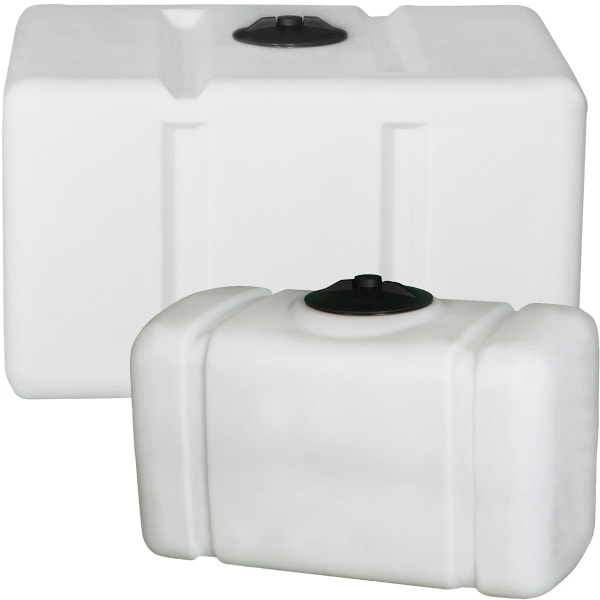
Utility tanks are compact, rectangular polyethylene tanks used to carry, store, and dispense liquid, often from a truck bed, trailer, cargo van, food truck, skid, or from a bench, table, floor, or shelving. Each tank is one piece, rotationally molded with a flat bottom that sits flush on surfaces. They are also known as plastic utility tanks, poly utility tanks, flat bottom utility tanks, rectangular utility tanks, loaf tanks, low profile utility tanks, and truck bed utility tanks. These tanks are widely used for mobile washing, auto detailing, pressure washer supply, spot spraying, de-icing brine, job site water and dust control, concession and camp water, small batch fertilizer and livestock water, and stationary shop storage.

Choosing a utility tank depends on five working details:

  1. The tank shape and mounting space
  2. Full load weight and vehicle payload
  3. The liquid type, specific gravity, and temperature
  4. Tank support and securing
  5. Outlets, fittings, and lids

Protank offers utility tanks in sizes ranging from 7 gallons up to 500 gallons in three model shapes: flat bottom, low profile, and loaf.

How to Choose a Utility Tank

1. Tank Shape and Mounting Space

The shape of a utility tank determines its available manufactured capacity range, its overall dimensions, its measured height on vehicles and center of gravity during transport, and whether the tank ships with a precut outlet.

Flat bottom utility tanks

Flat bottom utility tanks come in horizontal and upright styles. Horizontal models range from 7 to 200 gallons and 15" to 38" tall, making them longer and wider than they are tall. Upright models range from 20 to 80 gallons and feature a narrower footprint that stands up to 45" tall to better fit tight shelving, corners, and cabinet spaces. Flat bottom sizes may ship blank or with a 3/4" or 1" bulkhead outlet. Many feature molded body ribs that accept tank bands or function as tie-down points for straps.

Common uses: mobile washing and detailing; lawn care spot treatment; job site water; replacement tanks for small equipment.

Flat bottom utility tanks are the right choice when floor space, such as on a vehicle, is limited and it’s beneficial for the tank to arrive ready to attach a valve or hose.

Low profile utility tanks

Low profile utility tanks come in 110, 300, and 500 gallon sizes ranging from 18" to 23" tall. Their design spreads storage volume over a wider footprint that lowers overall load center of gravity for more stable transport. The reduced height lets them fit under covers, decks, and enclosed shelving. The low profile sizes are built as holding tanks and ship without an outlet. They can be field-modified to add fittings.

Common uses: trailer and skid mounted water supply; under deck mounting; concession and camp holding tanks; dust control.

Low profile utility tanks are the right choice when height is restricted on a transport vehicle, improved transport stability is a benefit, and the job needs more than 100 gallons of liquid storage. For dedicated water hauling, see also our Portable Water Tanks for more sizes and tank options.

Loaf tanks

Loaf tanks come in 50 to 500 gallon sizes and are molded with a rectangular body. They are blank tanks with an 8" fill with lid and no outlet to allow fitting placement where needed by the job, pump, skid, or equipment setup. Their box shape allows more liquid to be held within a set surface area. For example, the 200 gallon loaf tank occupies the same footprint as the 150 gallon flat bottom utility tank.

Common uses: sprayer setups; replacement tanks for equipment rigs; pickup bed and trailer water supply; custom plumbed systems.

Loaf tanks are the right choice when the container outlet location must match the setup, or when the most volume possible must fit within a particular area.

Utility Tank Shapes
Shape Capacity Height Outlet as molded Best fit
Flat bottom, horizontal 7–200 gal 15"–36" None on 7 and 16 gal; ¾" to 1" on larger sizes Truck beds, vans, small trailers
Flat bottom, upright 20–80 gal 34"–45" None on 20 gal; 1" on larger sizes Work van shelving, bed corners, tight floor space
Low profile 110–500 gal 18"–23" 1" on 110 gal; none on 300 and 500 gal Under truck bed covers and decks; trailers and skids
Loaf 50–500 gal 17"–31" None Skid builds, custom outlet placement


Measure the usable space, if applicable, before choosing a size to ensure fit. For a truck bed, that can mean width between wheel wells or bed length with closed tailgate. For a deck, cover, or shelf, measure the space available above the tank as well as the surrounding space.

2. Full Load Weight and Vehicle Payload

A utility tank should be sized according to the volume of liquid the job will use between refill opportunities or before spoilage. When used in transportation, utility tanks must also be sized to stay within the limit of the vehicle or trailer. For washing and spraying work, the flow rate of the pump can set needed tank volume. For example, a 4 GPM pump for power washing draws about 100 gallons in 25 minutes. For water supply and storage, size the tank to the water needed for use between refills.

The weight of a full load includes the liquid, the tank, any straps or bands, and any pumps, hoses, and plumbing. Water weighs 8.34 lbs per gallon. A full 150 gallon utility tank holds about 1,250 lbs of water; a full 300 gallon low profile tank about 2,500 lbs; a full 500 gallon tank about 4,170 lbs. Heavier liquids such as brines and fertilizers increase weight at the same volume. Compare the full or estimated load against the truck's payload rating and the trailer's gross vehicle weight rating (GVWR) before purchase and use.

Slosh Warning

Choose a tank capacity that can be transported full. A tank transported only partly filled shifts weight through liquid surges during braking and turning. Baffle balls can be added to help reduce surge in partial fill tanks.

3. Liquid, Specific Gravity Rating, and Temperature

The specific gravity (SG) rating of a polyethylene utility tank should match or exceed the weight of the liquid it will handle. Specific gravity is the ratio of a liquid's weight to water, meaning a 1.4 SG solution is 1.4 times heavier than water. A tank's SG rating indicates how heavy a liquid its walls have been built to hold. Protank's utility and loaf tanks are premium weighted 1.5 SG rated poly tanks for handling liquids up to about 12.5 lbs per gallon.

Temperature Detail and Common Liquid Weights

Liquids commonly stored in utility tanks are often beneath the 1.5 SG limit at normal temperatures:

  • Water: 1.0 SG or 8.34 lbs per gallon
  • Salt (sodium chloride) brine, about 23%: around 1.18 SG or about 9.8 lbs per gallon
  • Calcium chloride brine, about 32%: around 1.3 SG or about 11 lbs per gallon
  • 32% UAN fertilizer: around 1.33 SG or about 11.06 lbs per gallon

A polyethylene plastic tank's specific gravity rating is specified at 73°F, and its effectiveness rating decreases as liquid temperatures increase. Polyethylene tanks have a maximum storage temperature rating of 120°F. Liquids above that temperature can weaken and deform the tank.

Specific Gravity vs Chemical Compatibility

Utility tank SG rating is for liquid weight and wall strength only. Chemical compatibility is a separate product evaluation and must be checked for the tank, the bulkhead fitting, and its gasket. Each tank component and accessory (e.g., pumps, hoses, etc.) must be suitable for the chemical, at its stored concentration, and temperature. Include the product name or SDS on your quote, and we can help check tank and fitting compatibility.

Dedicated Service and Petroleum Restriction

Utility tanks should be used either to carry water or chemicals. A tank that has held chemicals or spray mixtures should not be used for water. Petroleum products are not recommended in polyethylene tanks due to tank wall softening and adsorption concerns. For handling oils, see Stackable Oil Tanks and Used Oil Tanks; for handling diesel exhaust fluid, see DEF Tanks.

4. Tank Support and Securing

Every utility tank needs full, level support under its base. Tanks should be loaded and secured to a vehicle before it is filled as full tanks are heavy and difficult to maneuver. Most flat bottom utility tanks have molded ribs that can be used as strapping points. Straps should be tightened until snug only; overtightening can stress and deform the tank. Upright tanks carry weight higher than horizontal tanks of similar capacity and should be secured to the vehicle's structure as well as the deck.

Optional galvanized steel support bands are available for the 50, 100, 150, and 200 gallon flat bottom tanks, and come two per tank. Bands help a tank maintain its shape and can assist in transport securement. Bands should be tightened until snug and not pull into the tank. A newly installed tank should be water tested before put into service.

Utility tanks are for above ground, atmospheric service only. They cannot be buried or pressurized. The lid should be opened when tanks are used with a pump.

5. Outlets, Fittings, and Lids

Depending on product size, a utility tank ships with a bulkhead outlet installed, a fitting supplied loose, or no outlet for field modification as needed.

Outlet and Lid Setup by Size
Shape Sizes Outlet Fill and lid
Flat bottom, horizontal 7, 16 gal None 5" threaded, vented
Flat bottom, horizontal 26 gal ¾" bulkhead 8" threaded, vented
Flat bottom, horizontal 45 gal 1" bulkhead, shipped loose 5" threaded, vented
Flat bottom, horizontal 50, 100, 150, 200 gal 1" bulkhead 8" threaded, vented
Flat bottom, horizontal 52, 68 gal 1" bulkhead 5" hinged
Flat bottom, upright 20 gal None 5" threaded, vented
Flat bottom, upright 35 gal 1" bulkhead 5" threaded, vented
Flat bottom, upright 55 gal 1" bulkhead, shipped loose 5" threaded, vented
Flat bottom, upright 80 gal None 5" threaded, vented
Low profile 110 gal 1" bulkhead 5" hinged
Low profile 300, 500 gal None 8" threaded, vented
Loaf 50–500 gal None 8" threaded, vented


Fittings and Connections

Verify standard fitting and gasket materials will be compatible with the chemical that the tank will carry. Stock fittings are polypropylene (PP); stock gaskets are EPDM. Utility tanks should be connected to pumps and plumbing using flexible hoses. Rigid piping attached directly to a bulkhead can stress fittings under tank movement and flexing. Manufacturer bulkhead instructions specify hand tightening until secure plus an extra quarter to half turn; overtightening can pinch gaskets and cause leaks.

Lids, Vents, and Pump Use

Utility tanks that are used to feed a pump, pressure washer, or sprayer can not be part of the pressurized system. For lids with a vent, the vent must be kept clear and unobstructed, or the lid kept open. A sealed or blocked vent can create a vacuum inside the tank when pumping. For lids without a vent, the lid must be removed before pumping. The stock 3/4" or 1" outlet also limits total pump draw rate.

Include on your quote request the fitting type and size you need and the pump or equipment the tank will feed, and we can help match outlets, valves, and fittings. See our fittings and accessories for available options.

Utility Tank Specifications


Flat Bottom Utility Tank Dimensions (Horizontal)
Capacity Dimensions (L × W × H) Fill / outlet Empty weight Full load, water / 1.5 SG Part #
7 gal 14" × 9" × 18" 5" / none 8 lbs 58 / 88 lbs UTN7
50 gal 38" × 19" × 23" 8" / 1" 27 lbs 417 / 625 lbs UTN50
52 gal 43" × 24" × 15" 5" hinged / 1" 32 lbs 434 / 650 lbs UTN52
150 gal 48" × 36" × 29" 8" / 1" 82 lbs 1,251 / 1,875 lbs UTN150
200 gal 48" × 36" × 36" 8" / 1" 115 lbs 1,668 / 2,500 lbs UTN200


Flat Bottom Utility Tank Dimensions (Upright)
Capacity Dimensions (L × W × H) Fill / outlet Empty weight Full load, water / 1.5 SG Part #
20 gal 15" × 11" × 34" 5" / none 10 lbs 167 / 250 lbs UTN20
35 gal 15" × 15" × 43" 5" / 1" 20 lbs 292 / 438 lbs UTN35
55 gal 18" × 18" × 44" 5" / 1", shipped loose 32 lbs 459 / 688 lbs UTN55


Low Profile Utility Tank Dimensions
Capacity Dimensions (L × W × H) Fill / outlet Empty weight Full load, water / 1.5 SG Part #
110 gal 48" × 35" × 18" 5" hinged / 1" 62 lbs 917 / 1,375 lbs UTN110
300 gal 95" × 56" × 19" 8" / none 159 lbs 2,502 / 3,750 lbs UTN300
500 gal 130" × 52" × 23" 8" / none 200 lbs 4,170 / 6,250 lbs UTN500


Loaf Tank Dimensions
Capacity Dimensions (L × W × H) Fill / outlet Empty weight Full load, water / 1.5 SG Part #
50 gal 41" × 27" × 17" 8" / none 26 lbs 417 / 625 lbs LON50
100 gal 41" × 27" × 30" 8" / none 41 lbs 834 / 1,250 lbs LON100
200 gal 48" × 36" × 29" 8" / none 61 lbs 1,668 / 2,500 lbs LON200
500 gal 92" × 48" × 31" 8" / none 186 lbs 4,170 / 6,250 lbs LON500

Full load is liquid weight only; water at 8.34 lbs/gal; 1.5 SG at 12.5 lbs/gal. Sizes shown are representative; see product listings for all sizes.


Utility Tank Materials, Standards & Compliance

Polyethylene Construction and Temperature Rating

Utility tanks are rotational mold manufactured. Poly rotomolding produces a seamless, one piece tank without joints or weak spots. Utility and loaf tanks are molded from linear high density polyethylene with UV stabilizers for outdoor service. Linear polyethylene tanks can be field-modified for installing bulkhead fittings and outlets where needed. On tanks kept outdoors long term, crazing or fine surface cracking on sun exposed walls is a sign of aging.

Drinking Water Use

NSF/ANSI 61 certified utility tanks are recommended for carrying or storing potable water that will be used for human consumption or be used in food preparation. All available poly utility tanks are made from FDA compliant resin for food and water contact (21 CFR 177.1520). For an NSF marked and certified tank when required by code or regulation, the tank must be made at a certified facility and request made on quote.

  • NSF/ANSI 61 certified plant: the manufacturer holds NSF/ANSI 61 certification at six fabrication sites, and certification is listed by model and plant
  • NSF/ANSI 61 marked tank: the finished tank was molded at a certified plant and carries an NSF marking or sticker

Utility tank color is used for product identification and limiting sunlight infiltration on black tanks, and does not indicate drinking water suitability. Concession trailers, food trucks, and other mobile food providers are often subject to local health department rules for freshwater and wastewater tanks. Confirm requirements before ordering.

Include your delivery state and ZIP on your quote, and we can help confirm an NSF marked model from the closest origin. For larger potable water storage and hauling, see our Water Tanks and Portable Water Tanks.

Hauling Regulated Liquids in Utility Tanks

When using utility tanks for chemicals, Section 14 of a liquid's safety data sheet (SDS) indicates if it is regulated as a hazardous material in transport. Some commonly used wash chemicals, pesticide mixes, and agricultural products carried on service vehicles are regulated. When they are, federal hazardous materials rules apply to the utility tank carrying the liquid:

  • Bulk packaging: tank sizes over 119 gallons are bulk packaging when transporting hazardous liquids regardless of fill level (49 CFR 171.8). For utility tanks, this applies to 150 gallon and larger tanks.
  • Packaging specification: utility tanks are not built or marked to DOT or UN packaging specifications.
  • Service vehicle exception: a limited exception for small quantities of certain hazardous materials carried on service vehicles may apply (49 CFR 173.6).
  • Agricultural exception: a narrow exception for agricultural products may apply only under specific service conditions (49 CFR 173.5(b)).

Confirm your liquid's hazmat status and how it can be hauled with your state department of transportation or the PHMSA before ordering. Regulated liquids that require specified bulk packaging are often shipped in UN/DOT marked IBC totes; see our IBC Tote Tanks.

Utility Tank Features → Applications

Flat Bottom and Molded Strap Ribs

Flat bottom utility tanks are molded with a rectangular base that sits level on a vehicle or surface. The square shape makes use of space that a round tank leaves empty. Tanks with molded wall ribs give a set path for straps over the tank and help keep them in position. Optional steel bands can be requested and added on select sizes.

Ideal for: truck bed and trailer mounting; service vans; mobile washing, landscaping and lawn care rigs.

De-risk: support the full bottom of the tank without overhangs or raised points, route straps or bands through the molded ribs, only tighten until snug.

Upright Narrow Body

Upright utility tanks stand 34" to 45" tall on a footprint as small as 15" × 11". This allows 20 to 80 gallons to be placed into a corner, cabinet, shelf bay, or other location where a horizontal tank won't fit.

Ideal for: service vans and enclosed trailers; bed corners; equipment racks; shelving and cabinet installations.

De-risk: secure upright tanks to vehicle structures as well as the floor, since their weight and center of gravity are higher than horizontal tanks.

Low Profile Body

Low profile utility tanks hold 110 to 500 gallons at 18" to 23" tall. The design keeps larger loads closer to decks or surfaces and the tank’s transport center of gravity low. The 300 and 500 gallon sizes are also built as holding tanks with a wide and flat design to fit under decks, covers, and trailers.

Ideal for: trailer and skid mounted water supply; under deck setups; concession and camp holding tanks; local dust control systems.

De-risk: check the full load weight against the vehicle’s limit rating; a full 500 gallon tank holds about 4,170 lbs of water.

Blank Loaf Tanks

Loaf tanks are molded blank, with an 8" fill and no outlet on all sizes. This allows bulkhead fittings to be installed in the location and size that the pump, rig, or system setup requires. The square, box-like body provides more volume per space than a rounded or nonuniform tank of similar measurement.

Ideal for: sprayer skid builds; replacement tanks for equipment rigs; custom plumbed systems; pickup bed and trailer water supply.

De-risk: confirm any client purchased and installed fittings, valves, and hoses are compatible with the liquid.

Wall Color and Level Visibility

Most utility tanks and loaf tanks are translucent, natural white polyethylene that keeps liquids visible from outside the tank for easy level checks. Many flat bottom sizes also feature external gallon markings for approximating current volume. Select sizes come in black, which improves sunlight blocking and limits algae growth in water stored long term in sun-exposed locations.

Ideal for: field mixing and refills; liquid level confirmation before travel; water storage with algae concerns.

De-risk: use tank gallonage marks as estimates; check volume level on black tanks before transport.

Utility Tank Applications
Application Typical tank What drives selection
Mobile washing and detailing Flat bottom; low profile Pump draw per job; outlet size; vehicle payload
Lawn care spot treatment Flat bottom; loaf Fitting and gasket compatibility; dedicated chemical service; see PCO Tanks for pest control tanks
De-icing and anti-ice brines Low profile; loaf Brine weight against the 1.5 SG rating; outlet placement; full load weight
Job site and dust control water Low profile; loaf Full load weight; trailer rating; surge on partial loads
Concession, food truck, and camp water Flat bottom; low profile NSF/ANSI 61 by model and plant; local health rules; separate fresh and wastewater tanks
Window cleaning Upright; low profile Van floor space; dedicated water service
Small batch fertilizer and livestock water Flat bottom; loaf Liquid SG; dedicated service; 119 gallon bulk threshold for regulated products
Sprayer skids and equipment rigs Loaf Outlet location; fitting compatibility; footprint
Stationary shop storage Flat bottom; upright Non-petroleum liquids only; chemical compatibility; floor space

The applications above are common use cases and should not be taken as an approval or guarantee for use. Liquid compatibility, vehicle ratings, and hauling requirements should be confirmed for each installation and scenario.

Utility Tank Bands, Fittings & Accessories

A utility tank is installed using fittings that connect it to the rest of the system setup or hardware that holds it to the deck if used in mobile applications. Some of this hardware is sized to the specific tank model.

Support bands. Optional, galvanized steel bands are available for select flat bottom utility tanks. They are supplied two per tank and sold separately. Bands help hold the tank's shape as well as its position on a surface.

Bulkhead fittings and gaskets. Bulkhead fittings are used to add or replace outlets on utility tanks. They are required to install valves, connect hoses or pumps for drawing, and on tanks that ship blank. The materials the fittings and gaskets are made of should be matched to the liquid type and concentration strength.

Replacement lids. Utility tanks feature 5" or 8" threaded vented lids. The 52, 68, and 110 gallon sizes have 5" hinged lids. Replacement lids must match the tank's fill opening and threading for secure, leak resistant fits.

Valves and flexible hose. Valves and flexible hoses connect utility tank outlets to pumps, (e.g., transfer pumps, roller pumps, diaphragm pumps), pressure washers, and spray equipment such as booms and nozzles.

Baffle balls. Baffle balls are designed to be placed inside a storage tank to help reduce liquid movement and surges during transport.

Level sensors. Level sensors can be added to monitor liquid levels without having to open the tank, some offer remote monitoring; ideal for when the tank is hard to reach, enclosed, or stored within a set space.

When mounting a utility tank for transport with straps, bands, or bolts, use hardware or equipment of sufficient strength rating to handle the full load weight and liquid surge force of the tank volume during movement. List the bands, fittings, and accessories the setup needs on your quote, and we can help match them based on the tank model and Protank’s selection. See our fittings and accessories for available options.

Utility Tank Freight & Delivery Logistics

Utility tanks ship from the manufacturing plant, storage yard, or depot nearest the delivery location that molds or has the specified model in stock. Shipping origin, NSF certification, and lead time vary by part number. Some sizes are molded at only one or two locations and can increase transit and lead time.

Smaller utility tanks, such as 7 to 45 gallon products, may be eligible for parcel shipment. Larger tanks ship less-than-truckload (LTL) freight; e.g., the 500 gallon low profile tank is 130" long. Request liftgate service if a dock or forklift is unavailable on site for delivery. Liftgate availability can be confirmed on quote. Confirm product weight and crew availability for offloading tanks by hand.

Inspect the tank and any fittings at delivery, and note any damage on the bill of lading before the driver leaves.

Ready to Choose a Utility Tank?Request a quote or talk to one of our team members. Tell us: the liquid to be carried along with its specific gravity and any temperature requirements, usage capacity and tank shape needs, where the tank will be placed and available space, outlet size and location, pump or equipment needed, if NSF/ANSI 61 certification is required, tank quantities, and the delivery ZIP code. We can help match a utility tank by shape, size, and fittings.


Frequently Asked Questions About Utility Tanks

The main differences are in body shape and outlet setup. Flat bottom utility tanks have varied shapes, rounded edges, and ship with a 3/4" or 1" outlet on most sizes. Loaf tanks have a squared, rectangular body and come as blank tanks with only a lid. In available capacity ranges, loaf tanks range from 50 to 500 gallons, and utility tanks from 7 to 500 gallons.

PCO tanks are sprayer tanks built and sized for pest control rigs and vehicles commonly used for these jobs in landscaping and groundkeeping. Utility tanks are general purpose rectangular tanks used for water, washing, brine, and other compatible liquids and come in various shapes and sizes to match the vehicle or location. For pest control service vehicles and applications, see our PCO Tanks.

Several sizes ship with no outlet:

  • the 7 and 16 gallon flat bottom tanks
  • the 20 gallon upright tank
  • the 300 and 500 gallon low profile tanks
  • loaf tanks of all sizes

Blank tanks can be fitted in the field with bulkhead fittings at the size and location the application needs.

Yes, when the tank meets the drinking water requirements for its use. Our polyethylene utility tanks are molded from FDA compliant resin, and NSF/ANSI 61 certification is available depending on the model and manufacturing facility. Concession stands and trailers, food trucks, and other mobile food operations often must meet local health department rules. A tank that has previously been used for chemicals should not subsequently be used for drinking water. Tell us if potable water certification is required on your quote.

No, the manufacturer recommends against storing petroleum products in these polyethylene tanks due to tank wall softening concerns. For oils and lubricants, see our Stackable Oil Tanks and Used Oil Tanks.

Yes, as a supply tank. Utility tanks are built for atmospheric pressures only. The tank can be used to feed pumps, pressure washers, or sprayers if it is never part of the pressurized system. In practice, this often means using a pump with the tank lid removed or with a low GPM flow pump on a tank with a vented lid.

Full weight depends on the tank’s size and the type of liquid stored. Water weighs 8.34 lbs per gallon and tank-compatible liquids can range up to 12.5 lbs/gal. For example, a full 150 gallon utility tank holds about 1,250 lbs of water to 1,875 lbs of 1.5 SG solution, a 300 gallon low profile tank about 2,500 to 3,750 lbs, and a 500 gallon tank about 4,170 to 6,250 lbs. Always compare total weight against the truck payload rating and a trailer's GVWR.

The manufacturer rating for these polyethylene tanks places a maximum storage temperature of 120°F. Continuous liquid temperatures above this ceiling can deform and weaken the tank. A poly tank's specific gravity rating is set at 73°F and lowers as the temperature of liquid cargo rises, meaning warm liquids reduce how heavy a load the tank can safely hold.

Steel support bands are optional for utility tanks to assist in tank rigidity, shape stability, and securing for transport.

Premium weighted utility and loaf tanks carry a 3 year manufacturer’s warranty from the date of fabrication. Warranty covers tanks installed and used according to the manufacturer's instructions. Non-recommended uses, such as petroleum storage or liquids above 120°F, fall outside normal service. Warranties typically cover manufacturing defects and claims remedied with a replacement tank.


Related Products

Name Length Width Height Size S.G. Part
7 Gallon Plastic Utility Tank 14" 9" 18" 14 L
9 W
18 H
1.5 UTN7
16 Gallon Plastic Utility Tank 20" 14" 17" 20 L
14 W
17 H
1.5 UTN16
20 Gallon Plastic Utility Tank 15" 11" 34" 15 L
11 W
34 H
1.5 UTN20
26 Gallon Plastic Utility Tank 25" 18" 20" 25 L
18 W
20 H
1.5 UTN26
35 Gallon Plastic Utility Tank 15" 15" 43" 15 L
15 W
43 H
1.5 UTN35
45 Gallon Plastic Utility Tank 38" 18" 22" 38 L
18 W
22 H
1.5 UTN45
50 Gallon Plastic Loaf Tank 41" 27" 17" 41 L
27 W
17 H
1.5 LON50
50 Gallon Plastic Utility Tank 38" 19" 23" 38 L
19 W
23 H
1.5 UTN50
50 Gallon White Plastic Loaf Tank 41" 27" 17" 41 L
27 W
17 H
1.5 LON50
52 Gallon Plastic Utility Tank 43" 24" 15" 43 L
24 W
15 H
1.5 UTN52
55 Gallon Plastic Utility Tank 18" 18" 44" 18 L
18 W
44 H
1.5 UTN55
68 Gallon Plastic Utility Tank 42" 27" 17" 42 L
27 W
17 H
1.5 UTN68
80 Gallon Plastic Upright Utility Tank 27" 18" 45" 27 L
18 W
45 H
1.5 UTN80
100 Gallon Plastic Utility Tank 43" 27" 29" 43 L
27 W
29 H
1.5 UTN100
100 Gallon Plastic Loaf Tank 41" 27" 30" 41 L
27 W
30 H
1.5 LON100
110 Gallon Plastic Utility Tank 48" 35" 18" 48 L
35 W
18 H
1.5 UTN110
150 Gallon Plastic Utility Tank 48" 36" 29" 48 L
36 W
29 H
1.5 UTN150
200 Gallon Plastic Utility Tank 48" 36" 38" 48 L
36 W
38 H
1.5 UTN200
200 Gallon Plastic Loaf Tank 48" 36" 29" 48 L
36 W
29 H
1.5 LON200
300 Gallon Plastic Utility Tank 95" 56" 19" 95 L
56 W
19 H
1.5 UTN300
300 Gallon Plastic Loaf Tank 63" 42" 30" 63 L
42 W
30 H
1.5 LON300
500 Gallon Plastic Utility Tank 130" 52" 23" 130 L
52 W
23 H
1.9 UTN500
500 Gallon Plastic Loaf Tank 92" 48" 31" 92 L
48 W
31 H
1.5 LON500
500 Gallon White Plastic Loaf Tank 92" 48" 31" 92 L
48 W
31 H
1.5 LON500