
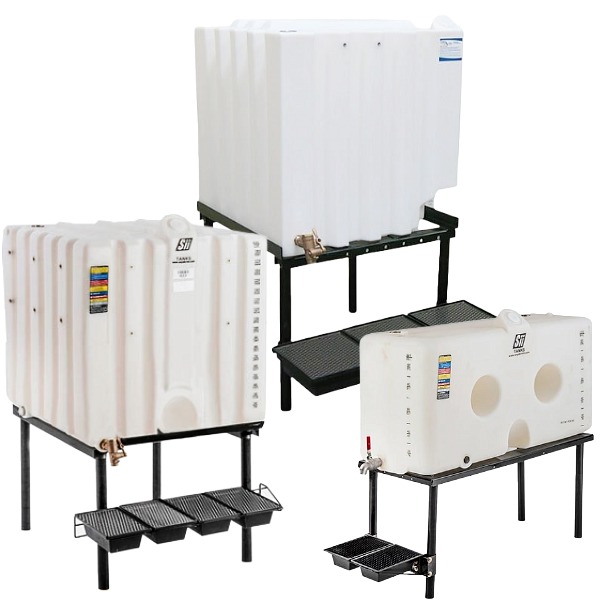
Stackable oil tanks are polyethylene bulk storage tanks used to dispense motor oil, ATF, hydraulic oil, lubricants, and antifreeze. Each tank comes with a steel stand for elevation and is built to interlock securely with the tank beneath it when stacked. Commonly known as stackable lube tanks, gravity feed oil systems, and bulk oil storage tanks, they are designed to replace 55 gallon drums in quick lubes, service bays, fleet shops, and plant lube rooms. Each tank holds one fluid, allowing a single stack to keep several lubricants separated, labeled, and ready for use from a single location. Stackable oil tanks are built for Class IIIB liquids with a flash point at or above 200°F. Fluids can be dispensed from these tanks via gravity flow or pneumatic pumps.
Choosing a stackable oil tank system depends on five working details:
The tank family and available floor space
The fluids stored and their usage rates
Stack height and overhead clearance at the install location
Drip tray or containment needs under the stand
Site fill method, dispensing, and accessories needed
A stackable oil tank system lets a shop consolidate several fluids into one footprint with viewable fluid levels and each dispense-ready at its own valve. Sites filled by bulk delivery from a lubricant supplier can also buy oil at a lower cost per-gallon than individual drum products and fill stackable oil tanks directly, removing drum handling and empty drum disposal. Protank offers stackable oil tank systems in three product lines, with individual tanks from 35 to 330 gallons and complete systems for holding 35 to 520 gallons.
Stackable oil tanks come in three product lines: the Cubetainer, the Slimtainer, and the Tote-A-Lube. Each has its own size and design. Tanks interlock for stacking only with tanks from the same line. The product line determines the tank sizes and stack combinations available. Every system ships with the tank or tanks, a standard 24" steel stand, and a gravity feed dispense kit with a 316 stainless steel spring release valve. Product options include multi-tank kits and kits with either a drip tray or containment basin. Multi-tank kits add the tubing and elbows that feed upper tanks down to the stand.
Cubetainer stackable tanks
Cubetainer tanks have a 36" × 36" boxlike footprint and come in 60, 80, 120, 180, and 260 gallon sizes. Capacity changes tank height only. Storage volumes can be mixed while keeping within an 82" stacked height limit for the tanks, not including the stand, up to four tanks high. This allows seventeen different system configurations with total capacity ranging from 120 to 360 gallons, with any individual tank capable of being used solely on its own. The 260 gallon tank is sold as a single-tank standard system. An assembled Cubetainer system with its drip tray will occupy 36" L × 48" W of floor space.
Common uses: quick lube and dealership service bays; fleet shops stocking several engine oil grades; lube rooms that can benefit from stocking high-volume and low-volume fluids in one stack.
Cubetainer tanks are the right choice when a shop needs several fluids in different volumes with an easy to organize square shape.
Slimtainer tanks
Slimtainer tanks hold 120 gallons in a 54" L × 22" W × 32" H body designed for wall lines and aisles. Slimtainer systems can be stacked one to two tanks high for 120 or 240 gallons. These tanks assemble at 64.5" L × 23" W when including the drip tray at the dispensing end. With the added containment option, they measure 74" L × 24.5" W. Wall anchor kits are available on request for the Slimtainer tanks when extra security and stability is needed for the stack.
Common uses: service bays and shops with low floor space; stations set against a wall or column; mobile-equipment shops that need to work around vehicle lanes.
Slimtainer tanks are the right choice for setups along wall lines, aisles, and bays with limited floor area.
Tote-A-Lube tanks
Tote-A-Lube tanks come in two sizes: 32" × 32" small tanks in 35, 70, and 120 gallons, and 42" × 42" large tanks in 130, 180, 240, and 330 gallons. The 35, 70, and 130 gallon tanks can be stacked four high, the 120 three high, and the 180 and 240 two high, providing twenty-three different configurations from 35 to 520 gallons. The 330 gallon tank is sold as a single tank system with a support hoop.
When assembled with drip tray, Tote-A-Lube tanks measure 36" L × 44" W (small) or 43" L × 54" W (large). A conversion bracket can be used to secure a small tank on top of a large tank. These tanks feature molded-in inserts for attaching accessories and placards. Welded floor plate legs, leg plate kits, leg support braces, and wall straps are available for securing tall stacks.
Common uses: fleet maintenance and heavy equipment shops; agricultural and construction equipment dealers; plant maintenance lube rooms; high volume engine and hydraulic oil storage.
Tote-A-Lube tanks are the right choice when per-fluid volumes run higher or a tall stack needs to be secured to the floor or wall.
2. Fluids and Usage Rate
Each tank in a stackable oil tank system holds one fluid and dispenses through a built-in valve. Tank choice should be sized to the stored fluid's usage rate between deliveries. High volume engine oil grades are recommended in 120 to 330 gallon tanks, and lower use fluids such as ATF, gear oil, or specialty grades are recommended in 35 to 80 gallon tanks. Keeping one fluid per tank and each tank clearly labeled will help prevent cross-contamination.
Oil viscosity increases as temperature drops. Heavy gear oils as well as any oil stored in an unheated building through winter will dispense slowly through a 1" gravity valve. A transfer pump keeps heavy or cold grades dispensing at a usable rate.
3. Stack Height and Overhead Clearance
A stack's height determines how much capacity can fit in one space, while available overhead clearance at the install location sets the allowable total height. Cubetainer tanks offer a combined stacked height of 82" or less above the stand base, putting assembled systems between 56.5" and 108" tall with the stand and base. Tote-A-Lube systems range from 37" to 123" tall, and Slimtainer systems are 56" or 84" tall.
System heights use the standard 24" stand. The Cubetainer and Tote-A-Lube systems can also be used with shorter or taller stands: 4", 10", 14", or 36" legs for Cubetainer, 36" stands for small Tote-A-Lube tanks, and 6" or 36" stands for large Tote-A-Lube tanks. A shorter stand can help fit a stack under a low ceiling, and a taller stand can raise valves for dispensing into larger containers. These non-standard stand heights are available on request.
Usable height is the distance below the lowest overhead obstruction at the install location, including lights, doors, ductwork, and sprinkler heads.
4. Drip Trays and Containment Basins
Standard oil gravity feed systems include a drip tray under the valves to catch drips and small spills during dispensing. The drip tray is not sized to hold a tank's full contents. For full secondary containment, a polyethylene or steel containment basin is placed under the stand and replaces the drip tray. These models are paired with a basin sized to the largest tank in the system, not total stack volume:
Stackable Oil Tank Containment Basins
Product line
Containment basin
Pairs with tanks
Cubetainer
203 gal poly
60 to 180 gal
Cubetainer
390 gal poly
260 gal, on stand
Slimtainer
145 gal poly with sump
120 gal
Tote-A-Lube, small
150 gal poly
35, 70, and 120 gal
Tote-A-Lube, small
85 gal steel
70 gal
Tote-A-Lube, small
150 gal steel
120 gal
Tote-A-Lube, large
265 gal poly
130, 180, and 240 gal
Tote-A-Lube, large
275 gal steel
130, 180, and 240 gal
Tote-A-Lube, large
210 gal steel, forklift-ready
180 gal
Tote-A-Lube, large
270 gal steel, forklift-ready
240 gal
Tote-A-Lube, large
375 gal steel
330 gal
Tote-A-Lube, large
370 gal steel, forklift-ready
330 gal
Cubetainer and Slimtainer containment basins are polyethylene. Tote-A-Lube systems can be purchased with both. Poly basins are lighter to place and move, while steel ones take less space, and forklift ready steel basins on 5" legs are available for 180, 240, and 330 gallon tanks.
5. Fill, Dispensing, and Accessories
Cubetainer and Slimtainer tanks have a 2" center fill opening, and Tote-A-Lube tanks have an angled 2" NPT fill port to accommodate direct filling from drums, totes, or a bulk delivery truck. A stacked oil tank system with the cap at 84" is at the maximum fill height many suppliers set for delivery. Setups above the max height use a remote fill kit.
Remote fill kits run a hose from the top tank to a cam-fitting fill connection and ball valve at the stand, bringing fill access to floor level. Remote fill kits are often used with a flow meter or high level alarm to prevent overfilling.
Gravity feed setups suit dispensing into cans, pails, and fill containers. A transfer pump can be added to individual tanks for metered, high volume, or direct dispensing. Their design allows one tank in a stack to run a pump and hose reel while others stay on gravity valves. Lube pump packages combine a hose reel and metered nozzle with an air-operated pump that runs on shop compressed air.
Stackable oil tank accessories can be specified on quote to match your work site needs:
Transfer pumps: side mounted pump plates, pump shelves, and pneumatic pump and reel shelves attached to molded-in inserts on 80 to 260 gallon Cubetainer tanks and large Tote-A-Lube tanks.
Top mounting: dispense accessories can be attached to top inserts on 120 gallon and larger Tote-A-Lube tanks.
Stands: steel stands 24" standard, with 4" to 36" stands available on request varying by product line and size.
Mobility: caster wheel kits for Cubetainer tanks up to 120 gallons; rigid poly pallets that stack on other Cubetainers for forklift, pallet jack handling; steel forklift bases and 8" caster bases for Tote-A-Lube tanks.
Desiccant breathers: for humid locations.
Fluid identification placards: 18" × 24".
Stackable Oil Tank Specifications
Stackable Oil Tank Sizes
Product line
Capacity
Tank dimensions (L × W × H)
Tank weight
Cubetainer
60 gal
36″ × 36″ × 17.5″
44 lbs
Cubetainer
80 gal
36″ × 36″ × 21.75″
50 lbs
Cubetainer
120 gal
36″ × 36″ × 30.5″
63 lbs
Cubetainer
180 gal
36″ × 36″ × 44″
105 lbs
Cubetainer
260 gal
36″ × 36″ × 57.25″
185 lbs
Slimtainer
120 gal
54″ × 22″ × 32″
70 lbs
Tote-A-Lube, small
35 gal
32″ × 32″ × 13″
23 lbs
Tote-A-Lube, small
70 gal
32″ × 32″ × 23″
32 lbs
Tote-A-Lube, small
120 gal
32″ × 32″ × 35″
50 lbs
Tote-A-Lube, large
130 gal
42″ × 42″ × 26″
58 lbs
Tote-A-Lube, large
180 gal
42″ × 42″ × 35″
76 lbs
Tote-A-Lube, large
240 gal
42″ × 42″ × 45″
135 lbs
Tote-A-Lube, large
330 gal
42″ × 42″ × 59″
165 lbs
Tank heights are measured to the top of the fill fitting, which nests into the tank above when stacked.
Stackable Oil Tank Models
Product line
Tank sizes
Tanks per system
System capacity
Size, assembled (L × W)
Cubetainer
60–260 gal
1–4
60–360 gal
36″ × 48″
Slimtainer
120 gal
1–2
120–240 gal
64.5″ × 23″; 74″ × 24.5″ with basin
Tote-A-Lube, small
35–120 gal
1–4
35–360 gal
36″ × 44″
Tote-A-Lube, large
130–330 gal
1–4
130–520 gal
43″ × 54″
Standard Cubetainer Tank Systems
Volume (gal)
Total capacity
System height
120
120 gal
56.5″
80 / 80
160 gal
65″
60 / 60 / 60
180 gal
70″
180
180 gal
70″
80 / 120
200 gal
74″
80 / 80 / 80
240 gal
83″
60 / 60 / 60 / 60
240 gal
83″
60 / 60 / 120
240 gal
83″
120 / 120
240 gal
83″
260
260 gal
83″
80 / 80 / 120
280 gal
91.5″
60 / 60 / 180
300 gal
95″
120 / 180
300 gal
95″
80 / 120 / 120
320 gal
100.5″
80 / 80 / 80 / 80
320 gal
100″
120 / 120 / 120
360 gal
108″
180 / 180
360 gal
108″
System heights are shown with the stand and base included. Tanks can be purchased and used independently. Other combinations within the 82" limit are available; request on quote
Standard Slimtainer Tank Systems
Volume (gal)
Total capacity
System height
120
120 gal
56″
120 / 120
240 gal
84″
System heights are shown with the stand and base included.
Standard Tote-A-Lube Tank Systems
Volume (gal)
Total capacity
System height
35
35 gal
37″
35 / 35
70 gal
47″
70
70 gal
47″
35 / 35 / 35
105 gal
57″
120
120 gal
59″
130
130 gal
50″
35 / 35 / 35 / 35
140 gal
67″
70 / 70
140 gal
67″
180
180 gal
59″
120 / 70
190 gal
79″
70 / 70 / 70
210 gal
87″
120 / 120
240 gal
91″
240
240 gal
69″
120 / 70 / 70
260 gal
99″
130 / 130
260 gal
73″
70 / 70 / 70 / 70
280 gal
107″
330
330 gal
83″
120 / 120 / 120
360 gal
123″
180 / 180
360 gal
91″
130 / 130 / 130
390 gal
96″
240 / 240
480 gal
111″
130 / 180 / 180
490 gal
105″
130 / 130 / 130 / 130
520 gal
119″
Tanks can be purchased and used independently. System heights are shown with the stand and base included.
Stackable Oil Tank Materials, Standards & Compliance
Polyethylene Construction and SG Rating
Stackable oil tanks are rotationally molded from high density polyethylene (HDPE). Rotomolding creates a one piece, seamless container that is strong and long lasting. Polyethylene is a synthetic thermoplastic material that does not rust, corrode, or shed scale and is ideal for storing oil and keeping it clean. The natural resin is translucent and fluid levels can be seen through the tank wall.
Stackable oil tanks are built to a 1.9 specific gravity (SG) rating, indicating the weight of liquid the tank wall has been engineered to handle. Most lubricating oils, hydraulic fluids, and solutions such as antifreeze are well under a 1.9 specific gravity rating and within the density rating for these tanks.
Stackable oil tanks are rated for continuous service up to 120°F (48°C). Tanks are built for atmospheric storage only.
Wetted Parts and Fluid Compatibility
Fluid compatibility in a stackable oil tank system applies to every wetted part: the tank, fittings, valves, tubing, elbows, and thread sealant. Materials used in a stackable oil tank:
Tanks: high density polyethylene (HDPE)
Drain and dispense fittings: stainless steel, 1" NPT
Valves: 316 stainless steel spring release valves; stainless, brass, and poly ball valves available
Tubing and elbows: 1" clear poly tubing with poly elbows and barbs; stainless elbow kits available
Manufacturer-listed fluids: motor oils, lubricants, hydraulic fluids, ATF, and antifreeze.
Potentially suitable, confirm compatibility: gear oils, power steering fluid, and industrial lubricants such as compressor, turbine, spindle, and way oils, by grade; straight cutting oils and soluble oil concentrates; vegetable oils for non-food use; silicone, white mineral, and transformer oils; water based coolant premix and methanol free washer fluid; detergents and car wash soaps; brake fluid; phosphate ester hydraulic fluids. Cooking oils for food service or food production need a food-contact review of tank components and local codes.
Not suitable, fuels, solvents, and flammable liquids: gasoline, diesel, kerosene, heating oil, and biodiesel; mineral spirits, naphtha, and other solvents; methanol based windshield washer fluid; any liquid with an SDS confirmed flash point below 200°F; and any heated fluids above the tank's rated service temperature.
Not recommended: citrus and terpene oils such as lemon oil, orange oil, d-limonene, pine oil, and turpentine as HDPE chemical resistance data indicates potential susceptibility to attack.
Diesel exhaust fluid (DEF) variants of the Cubetainer are available on request, but can be directly stored and easily dispensed from Protank's deploy-ready DEF Tanks. Used oil collection from service changes belongs in one of our Used Oil Tanks.
Fire Code Classification
Stackable oil tanks are built for Class IIIB liquids, chemicals, solutions, or fluids with a flash point at or above 200°F, which includes motor oils. Stackable poly lube systems are common in quick lube and service shops, and fire codes based on NFPA 30 allow polyethylene tanks for Class IIIB storage with approval from the authority having jurisdiction. Approval covers aboveground storage in areas not exposed to a spill or leak of Class I or Class II liquids such as gasoline or diesel, or storage inside a building protected by an automatic fire extinguishing system.
A lube room or wall location away from fuel handling, or a sprinklered building, generally fits these conditions. Indoor volume limits and acceptable placement in a lube room or service bay are set by the local fire code. Confirm any installation requirements with your local fire marshal or jurisdictional authority.
Containment and SPCC
Stackable oil tanks are classified as oil storage containers under the EPA's Spill Prevention, Control, and Countermeasure (SPCC) rule, 40 CFR 112. This rule counts every aboveground container of 55 gallons or more toward a facility's total oil storage, meaning every stackable oil tank size except the 35 gallon Tote-A-Lube. Containers under 55 gallons are excluded from the rule and the total, regardless of total quantity, though not exempt from liability should a spill affecting a waterway occur.
SPCC plans apply to facilities with more than 1,320 gallons of aggregate aboveground oil storage that could reasonably be expected to discharge oil to navigable waters or adjoining shorelines. When these regulations apply, bulk storage containers need secondary containment for the entire capacity of the largest single container, plus freeboard for precipitation if kept outdoors.
A stackable oil tank setup used to replace drums often keeps a business holding a similar volume of oil. 55 gallon drums already count toward the SPCC total, so a stack of replacement, long term, reusable tanks of similar capacity often doesn't change the facility's SPCC status. A shop holding under 1,320 gallons of oil doesn't need a plan, and a shop with an existing plan can typically update it to show the new containers. Businesses with 10,000 gallons or less of aboveground oil storage and no significant spill history can generally self-certify their SPCC plan without a professional engineer.
Whether a containment basin, a floor dike, or the building itself meets the facility's containment requirement is set by its SPCC plan and state and local rule requirements. Include your business's total aboveground oil storage on your quote, and we can help match containment options to the system.
Stackable Oil Tank Features → Applications
Interlocking Stack on a Shared Footprint
Stackable oil tanks interlock top to bottom, with molded ridges that seat each tank on the one below. Within each product line, tank sizes share one footprint, which allows tank storage capacities to match onsite usage frequencies in a single spot and setup. For example, a stack of three Cubetainers can hold up to 360 gallons while a stack of four Tote-A-Lube tanks can hold up to 520 gallons, each while keeping all fluids separated and ready for use.
Ideal for: lube rooms and service bays replacing rows of 55 gallon drums; shops stocking several oil grades.
De-risk: stack only tanks from the same product line, and keep Cubetainer stacks under the 82" stackable height limit above the stand.
Dispensing with Stainless Spring Release Valves
Each standard stackable oil tank dispenses by gravity through a 1" NPT 316 stainless steel spring release valve. Gravity feeding requires no pump, power, or air supply. Upper tanks feed down through 1" poly tubing and elbows to valves at the stand for easy operator access. The valve closes automatically when released by design. The included drip tray or containment basin below the valves is positioned to catch any drips.
Ideal for: drum replacement at quick lube and service bays; dispensing into measuring cans, pails, and fill containers.
De-risk: add a transfer pump for metered or high volume dispensing.
Translucent Tanks with Molded-In Level Markers
Natural HDPE is translucent, and the Cubetainer and Slimtainer tanks come with molded-in, inked level markers in gallons and liters for easy visualization and monitoring of ongoing volumes. This design on a stackable oil tank shows fluid levels at a glance without needing an external sight gauge.
Ideal for: inventory checks and reorder timing; job supplied sites where the delivery driver checks levels.
De-risk: label each tank with its fluid; fluid identification placards can be mounted to tank inserts.
Stainless Fittings and Accessory Inserts
Each tank dispenses through a stainless steel 1" NPT fitting. Cubetainer tanks from 80 to 260 gallons have six side inserts for mounting pump plates and shelves. Tote-A-Lube 120 gallon and larger tanks have four top inserts for top mounted dispense accessories, and the large Tote-A-Lube tanks have six side inserts. Front inserts are included on some models to hold fluid identification placards. These inserts allow pumps, hose reels, and labels to be mounted without tank modification.
Ideal for: shops adding a transfer pump or hose reel to match high volume use; fleet fluid stations.
De-risk: mount accessories only to the tank provided inserts.
Floor and Wall Securing
Tote-A-Lube systems offer legs with welded floor plates, floor-bolt leg plate kits, leg support braces, and wall straps sized to 32" and 42" tanks. Stand tabs bolt to the stand to secure the bottom tank. Slimtainer systems can be requested with a wall anchor kit for added stability.
Ideal for: tall stacks near forklift and vehicle traffic; sites where the local code official requires restraint.
De-risk: confirm anchoring or restraint requirements with the local code official before installation.
Stackable Oil Tank Applications
Application
Typical system
What drives selection
Quick lube and dealership service bays
Cubetainer stacks; Slimtainers
Several oil grades needed onsite; floor space; ceiling height
Engine oil volume; remote fill for bulk delivery; containment
Heavy equipment, construction, and agricultural shops
Tote-A-Lube
Hydraulic and engine oil volume; tank securing; forklift handling
Plant maintenance lube rooms
Cubetainer; Slimtainer; Tote-A-Lube
One tank per lubricant; labeling; desiccant breathers in humid locations
Food and beverage plants
Cubetainer; Tote-A-Lube
Dedicated storage for food grade lubricants; fluid review and compatibility
Lubricant jobbers and distributors
Tote-A-Lube
Refillable bulk tank at the customer site; remote fill; level visibility
The applications above represent common use cases, and should not be taken as approval of suitability or a replacement for an independent assessment.
Stackable Oil Tank Freight & Delivery Logistics
Stackable oil tank systems ship factory direct, FOB Minnesota, so freight cost varies with the configuration and delivery location. Lead times are confirmed on quote. Complete gravity feed systems ship LTL freight as kits.
Stackable systems are assembled on site using hand tools. The stand legs thread into the steel base, tanks interlock on each other atop the stand, and valves and elbows thread into the drain ports. Thread sealant should be used on every threaded fitting.
Request liftgate service if the site has no dock or forklift. Inspect tanks and components on delivery and note any damage on the shipment receipt before the driver leaves.
Ready to Configure a Stackable Oil Tank System?Request a quote or talk with one of our tank specialists. Tell us the fluids you store and the approximate monthly use of each. Know your site details such as the available floor space and ceiling height at the install location, how bulk oil is delivered, and your business's total aboveground oil storage. We can help match a tank product line, stack setup, and containment option to the application and confirm expected freight times. Ask about available pump kits and accessory options for our stackable oil tanks.
Frequently Asked Questions About Stackable Oil Tanks
For most shops that dispense several fluids and go through appreciable volumes every week, yes, stackable oil tanks are an upgrade with benefits over 55 gallon drums. Bulk oil that gets delivered into a refillable tank typically costs less per gallon than drummed oil, and a stackable system filled this way removes drum handling, drum pumps, drum waste from residual product, and the costs of disposing empty drums. One stack keeps several fluids labeled and ready for dispensing in a single, self-contained space, with levels clearly visible through the tank wall, so no guessing or drum inspections. A grade or type of oil used so rarely that one drum lasts many months may still be better kept in a drum. Tell us your monthly use by fluid and we can help size a system.
Total stack height depends on the product line. Cubetainer tanks can be stacked up to four high up to a combined height of 82" or less above the stand base. The tallest Cubetainer systems stand 108" including the stand and base. Tote-A-Lube systems stack up to four tanks and reach 123". Slimtainer systems stack two tanks high to 84". A remote fill kit, requested on quote, is used to handle filling the top tank on systems 84" and taller.
Yes, within a single product line. Every Cubetainer size shares a 36" × 36" footprint, and sizes can be mixed while keeping within the height limit; e.g., 60/60/120 or 80/120/120. The Tote-A-Lube has small tanks (35, 70, 120) that stack together and large tanks (130, 180, 240) that stack together, and a conversion bracket must be used to secure a 32" small tank to a 42" large tank. Tanks from different product lines don't interlock and cannot be stacked together without a conversion kit.
Fluids listed by the manufacturer for use in stackable oil tanks include: motor oils, lubricants, hydraulic fluids, ATF, and antifreeze, all Class IIIB liquids. Gasoline, diesel, kerosene, solvents, and methanol windshield washer fluid are not suitable. Citrus and terpene oils are not recommended. Diesel exhaust fluid should be stored in dedicated DEF compatible equipment; see DEF Tanks. For gear oils, industrial lubricants, cutting oils, vegetable oils, brake fluid, phosphate ester fluids, or any fluid not listed, send the SDS with your quote request and we can help confirm compatibility.
Yes, every stackable oil tank of 55 gallons or more counts toward your total aboveground oil storage under the EPA's SPCC rule, 40 CFR 112. This includes every stackable size except the 35 gallon Tote-A-Lube. Drums, totes, and other oil containers of 55 gallons or more count as well. Vegetable oils and animal fats also count as oils under SPCC. Facilities with more than 1,320 gallons that could reasonably be expected to discharge oil to navigable waters or adjoining shorelines need an SPCC plan that will set their containment requirements. If unknown, confirm your business's SPCC status with your plan preparer or an environmental consultant.
No, the drip tray is used to catch drips and small spills at the dispensing valves and is not sized to hold a tank's contents should the container fail. Secondary containment is typically sized to hold the entire volume of the largest tank in a system. For secondary containment on stackable oil tanks, a polyethylene or steel containment basin can be used to replace the drip tray under the stand. Basins are available for every product line in sizes to match the largest tank in the system. Note that the 330 gallon Tote-A-Lube tank pairs with steel basins only. Whether a unit satisfies your individual containment requirement will depend on your SPCC plan and local rules.
No, stackable oil tank systems are built to store and dispense new fluids. Used motor, hydraulic, transmission, and gear oils should go in a dedicated collection tank. The EPA rules at 40 CFR 279.22 require used oil tanks and containers to be in good condition, free of leaks, and labeled "Used Oil." Used oil tanks typically feature a built-in filter screen and tank-in-a-tank design. Adding used oil to a stack where new fluids are also kept risks cross contamination, especially if the container will ever be used for anything else. See our Used Oil Tanks for tanks built for used oil collection.
Slimtainer tanks are 22" deep, and an assembled Slimtainer system occupies 23" of space along a wall, or 24.5" when used with the containment basin. To move a tank through a standard doorway, its shortest dimension has to clear the door's actual opening while accounting for the hinges. The 60 and 80 gallon Cubetainer tanks (17.5" and 21.75" tall) will pass through on their side. The 120 gallon Cubetainer is 30.5" tall and needs at least that much in clear opening, which a nominal 32" door may not provide.