
- Home /
- Plastic Tanks /
- Used Oil Tanks
Used Oil Tanks
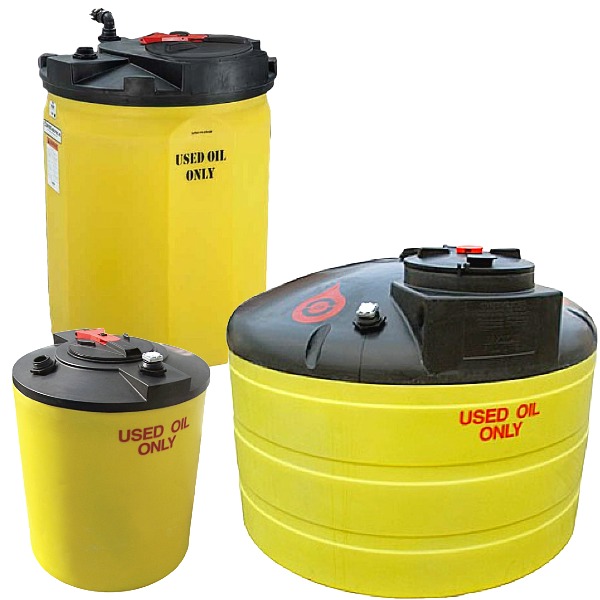
Used oil tanks are double walled plastic tanks used to collect and store oil drained from vehicles and equipment during servicing or oil used in industrial operations. They allow bulk quantities of waste oil to be gathered in a single container until it can be pumped out by a used oil hauler. Commonly known as waste oil tanks, used oil collection tanks, and double wall waste oil containers, they can hold used motor, hydraulic, transmission, and gear oils from quick lubes, repair shops, dealership service bays, fleet centers, equipment depots, and plant maintenance areas.
Each used oil tank is engineered as a tank-in-a-tank system. The main storage tank sits inside an outer containment tank sized to 110% or more of its capacity. These tanks feature a lockable manway with a strainer basket to catch filters and debris as oil is added, and a suction pipe for fast, easy connections and pumping when it’s time for removal. While standard bulk polyethylene tanks are often restricted from storing petroleum, used oil collection tanks are a dedicated product line built for this service.
Choosing a used oil tank depends on five working details:
- The tank series and available floor space
- Used oil volume and pickup interval
- Indoor or outdoor placement
- Filling and pump-out access
- Overfill control and leak inspection
Our used oil tanks give shops a single collection point for drained oil, with containment built into the tank footprint rather than relying on an external berm or spill pallet. Protank offers used oil tanks in two product lines, translucent and UV stabilized in sizes from 100 to 1,000 gallons.
How to Choose a Used Oil Tank
1. Tank Series and Available Floor Space
Used oil tanks come in two series options: translucent and UV stabilized. Both series are dual walled tanks and feature a top mounted suction pipe for emptying, a hinged lockable manway, and strainer for pouring in drained oil. The series determines the sizes available, whether a level gauge and overfill shut-off come standard, and how the containment space between the walls is accessed.
Translucent used oil tanks
Translucent used oil tanks come in 100, 150, 200, and 385 gallon sizes. The 100 to 200 gallon tanks range from 34.25" to 40" in diameter, and the 385 gallon tank is a wider, shorter body with a 64.5" diameter. Each translucent used oil tank includes the following features:
- a 12" hinged locking manway, 16" on the 385 gallon, with a molded basin and removable strainer basket
- an overfill shut-off in the basin drain
- a liquid level gauge
- a plugged port for containment space access
The outer tank is a translucent safety yellow that allows the containment space to be checked by sight.
Common uses: quick lube and dealership service bays; indoor shops with a single shared dump point; facilities running routine visual tank inspections.
Translucent used oil tanks are the right choice for indoor placement where a standard level gauge, overfill control, and visible containment space simplify routine tasks.
UV stabilized used oil tanks
UV stabilized used oil tanks come in 120, 150, 275, 360, 500, and 1,000 gallon sizes. The 120 and 150 gallon tanks are 34" in diameter, the 275 to 500 gallon tanks 47" to 53" in diameter, and the 1,000 gallon tank 80.5" in diameter. Each UV stabilized used oil tank features a black primary tank inside an opaque, UV stabilized, safety yellow outer tank for indoor or outdoor installation. Features by size:
- The 120 and 150 gallon tanks have a 14" hinged locking manway with a 12" strainer.
- The 275 gallon and larger tanks have an 18" hinged locking manway with strainer.
- The 275, 360, and 500 gallon tanks have forklift channels.
- All sizes have four molded tie-down lugs.
A level gauge is available as a factory-installed option and quote add-on.
Common uses: fleet and trucking maintenance; agricultural and heavy equipment shops; industrial facilities; outdoor or covered collection points; higher volume shops and those on longer pickup intervals.
UV stabilized used oil tanks are the right choice for outdoor placement, holding larger volumes between pickups, or sites where the tank needs to be anchored or moved by forklift.
2. Used Oil Volume and Pickup Interval
A used oil tank size should be chosen based on the volume of oil drained from onsite activities between hauler pickups. Pickups are arranged with the hauler, and some require a minimum volume or charge a per-stop fee, which can influence ideal tank size. In these cases, a tank that holds more can increase time between pickups and spread costs over more gallons, while a smaller tank may need more frequent service.
Usable capacity is less than a tank's nominal capacity, and some oil will stay below the end of the suction pipe after each pickup, where sludge and solids will settle over time.
To estimate size, multiply the gallons drained in a typical workweek by the amount of time between pickups, then choose a tank with a nominal capacity sufficient for that volume with extra room for residual oil, a late pickup, or increase in onsite activities.
When choosing a used oil tank, know that it will count toward a facility's aboveground oil total under the EPA's SPCC rule. When added to bulk oil tanks and drums already on site, it can bring a shop over the 1,320 gallon threshold for an SPCC plan.
3. Indoor or Outdoor Placement
Translucent used oil tanks are not listed with UV inhibitors and are suited to indoor installation. UV stabilized used oil tanks can be placed indoors or outdoors and feature four tie-down lugs for securing the tank when placement anchoring is needed. Used oil tanks also fall under fire code location rules for plastic tanks; see Fire Code Classification below.
Oil viscosity increases as temperature drops. Oil collected in an unheated building or outdoors through winter will pump out slower at pickup.
Check each used oil tank height against benches, shelving, overhead doors, and lights at the install location, and check diameter against the floor space and every doorway the tank has to pass through. Overall dimensions are listed in the Sizes table, with heights measured to the top of the manway and fittings.
4. Filling and Pump-Out Access
Used oil tanks often have waste oil added either through direct, manual means, such as pouring from a drain pan, or discharge through a hose from a drain cart. In both cases, the top of the tank has to be reached, and tank height determines if manual filling is an option. Translucent used oil tanks are 42" to 55.4" tall, and UV stabilized tanks range from 51.1" to 80.7". Shorter tanks keep the manway more within reach for pouring by hand, while taller tanks are filled more easily from a drain cart.
Used oil tanks are pumped out and emptied from the top. A suction pipe runs from a top bulkhead and pipe fitting to near the tank floor. These tanks have no bottom outlet. An oil hauler uses this top fitting to connect and empty the tank out by pump truck. UV stabilized models have a 2" male camlock adapter. Translucent models have a 2" male adapter and cap. Share the tank coupling setup with your hauler before the first pickup to ensure they have the right hose hookup.
A used oil tank should be placed where the hauler's hose can easily reach it from the truck. A tank placed at an outside wall can be plumbed for pump-out through the wall.
5. Overfill Control and Leak Inspection
Translucent used oil tanks include a liquid level gauge and an automatic overfill shut-off in the basin drain as standard. The shut-off closes and stops oil from entering the primary tank once it is full. UV stabilized used oil tanks have no overfill shut-off, and can be ordered with a factory installed level gauge for monitoring fill volume.
Businesses with an SPCC plan need a method for overfill prevention on each bulk storage container, such as a direct vision gauge that can be monitored as techs fill the tank. A UV stabilized tank going into an SPCC facility may need the optional gauge, another overfill device, or an alternative method. Level gauges need regular testing to ensure accurate performance.
The containment space between the walls should be checked as part of routine tank inspection. Oil found in the containment space usually indicates the primary tank has leaked. In this event, the tank should be taken out of service and emptied.
Used Oil Tank Specifications
| Capacity | Series | Dimensions (D × H) | Manway | Forklift channels | Tank weight | Part # |
|---|---|---|---|---|---|---|
| 100 gal | Translucent | 34.5" × 42" | 12" | No | 100 lbs | WOC100 |
| 150 gal | Translucent | 34.3" × 53.6" | 12" | No | 104 lbs | WOC150 |
| 200 gal | Translucent | 40" × 55.4" | 12" | No | 145 lbs | WOC200 |
| 385 gal | Translucent | 64.5" × 46.8" | 16" | No | 250 lbs | WOC385 |
| 120 gal | UV stabilized | 33.8" × 51.1" | 14" | No | 100 lbs | WOS120 |
| 150 gal | UV stabilized | 33.8" × 61.6" | 14" | No | 110 lbs | WOS150 |
| 275 gal | UV stabilized | 47" × 62.4" | 18" | Yes | 200 lbs | WOS275 |
| 360 gal | UV stabilized | 53" × 62.4" | 18" | Yes | 234 lbs | WOS360 |
| 500 gal | UV stabilized | 53" × 80.7" | 18" | Yes | 280 lbs | WOS500 |
| 1,000 gal | UV stabilized | 80.5" × 69" | 18" | No | 450 lbs | WOS1000 |
Heights are overall, measured to the top of the manway and fittings.
Used Oil Tank Materials, Standards & Compliance
Polyethylene Construction and SG Rating
Used oil tanks are rotationally molded from premium, professional grade polyethylene. The rotational molding process produces one piece, seamless primary and containment tanks. They are built for aboveground, atmospheric storage only. They are not designed for burial.
UV stabilized used oil tanks are built to a 1.9 specific gravity (SG) rating, making the walls engineered to hold liquids up to about 15.8 lbs per gallon. Used oil typically runs 0.8 to 1.0 SG (~ 6.6 to 8.3 lbs/gal), making tank ratings structural for operational safety. Specific gravity does not indicate chemical compatibility or fire rating.
Standard fittings, seals, and suction pipes on these tanks are of materials with known compatibility and suitability for waste oil applications. Any piping or fittings added on site should be rated for petroleum oils.
Used Oil Storage Rules
EPA used oil management standards within 40 CFR 279 set four storage requirements for businesses that generate used oil:
- Store used oil only in tanks or containers.
- Keep tanks and containers in good condition, with no leaks.
- Label tanks and containers clearly with the words "Used Oil."
- Respond to any release by stopping the leak, containing and cleaning up the oil, and repairing or replacing the damaged tank.
Used oil tanks come with the marking "USED OIL ONLY" stenciled on two sides. Manufacturers state these tanks meet the 40 CFR 279.22 storage requirements, but the duties to ensure compliance belong to the facility, with the tank only one part of meeting regulatory guidelines.
Federal rules don't require shops that generate used oil to obtain an EPA identification number, though some states do, e.g., California. Similarly, some states regulate used oil more strictly than federal rules and may impose added labeling, accumulation time, and containment standards. Always verify your local state regulations and ensure a container product will meet those requirements.
What Can Go in a Used Oil Tank
Under 40 CFR 279, used oil is refined or synthetic oil that has been contaminated through use in vehicles, equipment, or industrial processes. Antifreeze, fuels, and products defined as cleaners or solvents are not used oil and should be collected separately. Drained oil should be allowed to cool before it is poured into a poly used oil tank.
Used oil: used motor oil, transmission fluid, hydraulic fluid, gear oil, compressor oil, and oil-based heat transfer fluids.
Used oils can be collected together in one used oil tank: motor oils of any grade, conventional or synthetic, along with transmission, hydraulic, gear, and compressor oils.
Keep out of a used oil tank: antifreeze; water-based coolants; gasoline, diesel, and kerosene; brake fluid; brake cleaner, carburetor cleaner, and part washing solvents; any other cleaner or solvent.
Used oil that contains more than 1,000 ppm total halogens (e.g., fluorine, chlorine, bromine) is presumed to be hazardous waste, unless it can be shown otherwise. Chlorinated brake and parts cleaners are a common source due to their presence and use in these industries. Even a small amount poured into a used oil tank can cause contents to exceed the limit.
Fire Code Classification
Used oil typically has a flash point above 200°F, making it a Class IIIB liquid. Contamination from fuels or solvents can lower the collective flash point and change the classification. Plastic used oil tanks are commonly used in quick lube and service shops. Fire codes based on NFPA 30 allow polyethylene tanks for Class IIIB storage, often with approval from the authority having jurisdiction. Approval commonly applies to two settings: storage in areas not exposed to a spill or leak of Class I or Class II liquids such as gasoline or diesel, or storage inside a building with an active, approved automatic sprinkler or automatic fire extinguisher system.
An indoor location without sprinklers may need specific approval and may not qualify at all. Confirm installation requirements with your fire marshal or jurisdictional authority.
Containment and SPCC
Used oil tanks are oil storage containers that fall under the EPA's Spill Prevention, Control, and Countermeasure (SPCC) rule, 40 CFR 112. Alongside new oil, used oil counts toward a business’s total aboveground oil storage. SPCC plans apply to sites with oil storage exceeding 1,320 gallons in container sizes 55 gallons or more. It must also be reasonable to assume the facility could accidentally discharge oil to nearby waters. Businesses with 10,000 gallons or less total aboveground oil storage and no significant spill history may qualify for a self-certified SPCC plan without a professional engineer where the state allows.
Under EPA SPCC rules, bulk oil containers need secondary containment for the entire capacity of the largest single container. Our double wall used oil tanks are built to hold at least 110% of the primary tank's capacity, meeting the EPA’s criteria. An SPCC plan also has mandatory inspection guidelines that apply to dual walled containers. A shared containment area, e.g., a berm, curbed floor, or spill basin around several containers, is a common alternative to a double wall tank.
While these products meet the rule’s requirement to contain the full capacity of the largest container, whether a double walled used oil tank meets a company's individual containment requirement is set by its SPCC plan and by state and local rules. Include your total aboveground oil storage on your quote, and we can help match a used oil tank to your needs.
Used Oil Tank Features → Applications
Tank-in-a-Tank Secondary Containment
The primary storage vessel in each used oil tank sits inside a molded outer tank sized to hold 110% or more of its capacity. This design puts a secondary containment tank around the main holding tank that secures it during use. A leak from the primary tank is captured and held in the space between the walls, while keeping containment and service to a single footprint the size of the tank itself.
Ideal for: indoor service bays and lube rooms without space for a berm or external basin; shops replacing drums on spill pallets.
De-risk: check the containment space for oil leaks during routine tank inspections.
Top Draw Pump-Out with No Bottom Outlet
Used oil tanks empty through a 2" suction pipe mounted at the top of the tank as the primary tank has no bottom drain, valve, or fitting. No penetration at the base of the tank means no bottom valve to leak or to be accidentally left open.
Ideal for: sites served by a waste oil hauler; shops on a set pickup schedule.
De-risk: any external, permanent piping connected to the tank should be supported independently; consider adding a tank level indicator for easy monitoring of storage levels and when it’s time for a pump-out.
Lockable Manway and Strainer Basket
Spent or drained oil is poured into a used oil tank through a hinged manway measuring 12" to 18" that can be fitted with a safety lock for security between uses. Manways feature a removable strainer basket. The strainer catches old filters and any potential mechanical debris before they reach the primary tank.
Ideal for: quick lubes and multi-technician shops sharing one dump point; fleet yards with after hours access.
De-risk: lock the manway lid between uses to prevent unauthorized access or use and to keep external contaminants out of the tank.
Tie-Down Lugs and Forklift Channels
UV stabilized used oil tanks have four molded tie-down lugs on every size for securing the tank in place for outdoor installation in regions prone to high winds or for relocation on a vehicle when empty. The 275, 360, and 500 gallon tanks also have forklift channels to streamline onsite placement or repositioning the tank using a forklift or pallet jack.
Ideal for: outdoor and wind exposed sites; yards and bays that are or may be remodeled, adjusted, or modified over time.
De-risk: only move used oil tanks when empty.
| Application | Typical tank | What drives selection |
|---|---|---|
| Quick lube and dealership service bays | Translucent; UV stabilized 120 to 275 gal | Daily drain volume; pickup interval; indoor floor space; overfill control in a busy shop |
| Fleet maintenance shops (trucking, municipal, transit) | UV stabilized 275 to 1,000 gal | Engine oil volumes; outdoor placement; forklift handling; facility SPCC total |
| Heavy equipment, construction, and agricultural shops | UV stabilized | Hydraulic and engine oil volumes; outdoor or seasonal sites; tie-downs; cold weather pump-out |
| Plant maintenance | Translucent; UV stabilized | Hydraulic, gear, and compressor oils; keeping coolants and solvents separate; inspection schedule |
| Marinas and boatyards | UV stabilized | Outdoor placement near water; SPCC requirements; local used oil rules |
The applications above represent common use cases, and should not be taken as approval of suitability or a replacement for independent assessments.
Used Oil Tank Freight & Delivery Logistics
Used oil tanks ship from multiple warehouse and factory origins, so freight cost can vary by tank model and delivery location. Tanks ship LTL freight. Request liftgate service if your business or worksite has no dock or forklift. Liftgate availability for taller and heavier models can be confirmed on quote. Always inspect the tank and fittings on delivery. Note any damage on the bill of lading and contact us or reject the shipment before the driver leaves.
Frequently Asked Questions About Used Oil Tanks
Not without approval from the tank manufacturer. Polyethylene tank manufacturers restrict petroleum storage in standard tanks due to concerns for permeation and wall softening over time. Used oil collection tanks are an exception that have been manufactured for the service. Standard double wall tanks are also not recommended for used oil because of the contaminants that waste oil can carry and potential interactions. Each used oil tank has a strainer basket at a lockable manway, top draw fitting for pump outs, and an outer tank sized to 110% or more of the primary tank. For chemical storage with built-in containment, see our Double Wall Storage Tanks.
In shop use, the two terms usually mean the same thing. From the EPA, "waste oil" is broader and can include oil that was never used, such as fuel tank bottoms, which isn't used oil under 40 CFR 279. "Used oil" is the EPA's regulatory term for refined or synthetic oil contaminated through use, and the rule assumes used oil will be recycled. A waste oil tank and a used oil tank are the same collection tank, built for used oil. Tank markings should follow the term your state requires: federal rules call for "Used Oil" on tanks and containers, while state rules may vary, for example, Massachusetts requires used oil storage areas to be marked "Waste Oil."
A stackable oil tank is used to store and dispense new oil, while a used oil tank is used to collect drained oil for hauler pickup. Stackable oil tanks are filled from drums or bulk delivery and dispense through valves or a pump. Used oil tanks take in spent oil through a strainer at the manway and are emptied from the top by pump truck. Many shops use both. Note that each tank 55 gallons or more counts toward the facility's aboveground oil total under SPCC rules. New and used oil should be kept in separate tanks. See our Stackable Oil Tanks for bulk new oil storage and dispensing.
Anything that isn't used oil should not be put into a waste oil tank. Examples include: antifreeze, gasoline, diesel, kerosene, brake cleaner, carburetor cleaner, and part washing solvents. These should be collected separately to avoid a hazardous waste classification or a higher pumping charge. Used oil with more than 1,000 ppm total halogens is presumed to be hazardous waste. Chlorinated cleaners are a common source, so even a small amount from brake or parts cleaner can push the entire used oil tank contents over the limit. Fuel and solvents can also lower the oil's flash point and flammability rating, which too can change its classification and handling requirements. If anything other than used oil gets put into the tank, tell your hauler before the next pickup.
A business typically only needs an SPCC plan if the facility holds more than 1,320 gallons of aboveground oil storage and could reasonably be expected to discharge oil to navigable waters or adjoining shorelines. The total counts every oil container of 55 gallons or more by its capacity, not the amount of oil on hand. This includes used oil tanks, new oil tanks, drums, totes, and oil filled equipment such as hydraulic reservoirs. Businesses with 10,000 gallons or less of aboveground oil storage and no significant spill history can often certify their plan without a professional engineer, if the state allows. If unsure, confirm your SPCC status with the plan preparer or an environmental consultant.
It can, but the facility's SPCC plan determines if it does or not. Oftentimes, it comes down to total spill risk, which includes site conditions, proximity to protected environments, and a method’s suitability to mitigate the risk. A double wall used oil tank provides secondary containment sized to hold 110% or more of the primary tank's capacity, meaning it can handle the main tank's full contents if it leaks. EPA guidance on double wall tanks as containment does not specifically address polyethylene tanks, and whether a double wall tank meets a plan is a call made by the preparer of that plan. Double wall containers also need routine inspection to ensure they are still providing adequate protection.
Used oil tanks are emptied from the top using a hauler's pump truck. A 2" suction pipe runs from a top-mounted fitting to near the tank floor. These tanks have no bottom outlet. UV stabilized models have a 2" male camlock adapter for connections. Translucent models have a 2" male adapter; confirm the fitting with your hauler before the first pickup. A small volume of oil will stay below the end of the suction pipe after each pickup. Off-site pickups must use a transporter with an EPA identification number. Self hauling 55 gallons or less to a collection center is an exception.
Related Products
- Gallon Range
- Translucent
- UV Inhibitors
| Name | Diameter | Height | Size | S.G. | Part |
|---|---|---|---|---|---|
| 100 Gallon Plastic Waste Oil Tank | 35" | 41" | 35 Ø 41 H |
WOC100 | |
| 120 Gallon Plastic Waste Oil Tank | 33" | 51" | 33 Ø 51 H |
1.9 | WOS120 |
| 150 Gallon Plastic Waste Oil Tank | 34" | 62" | 34 Ø 62 H |
1.9 | WOS150 |
| 150 Gallon Plastic Waste Oil Tank | 34" | 49" | 34 Ø 49 H |
WOC150 | |
| 200 Gallon Plastic Waste Oil Tank | 41" | 53" | 41 Ø 53 H |
WOC200 | |
| 275 Gallon Plastic Waste Oil Tank | 47" | 63" | 47 Ø 63 H |
1.9 | WOS275 |
| 300 Gallon Plastic Waste Oil Tank | 57" | 45" | 57 Ø 45 H |
1.9 | ODW0300 |
| 360 Gallon Plastic Waste Oil Tank | 53" | 63" | 53 Ø 63 H |
1.9 | WOS360 |
| 385 Gallon Plastic Waste Oil Tank | 64" | 40" | 64 Ø 40 H |
WOC385 | |
| 405 Gallon Plastic Waste Oil Tank | 48" | 73" | 48 Ø 73 H |
1.9 | WOS405 |
| 500 Gallon Plastic Waste Oil Tank | 57" | 69" | 57 Ø 69 H |
1.9 | ODW0500 |
| 500 Gallon Plastic Waste Oil Tank | 53" | 81" | 53 Ø 81 H |
1.9 | WOS500 |
| 750 Gallon Plastic Waste Oil Tank | 73" | 67" | 73 Ø 67 H |
1.9 | WOS750 |
| 1000 Gallon Plastic Waste Oil Tank | 81" | 69" | 81 Ø 69 H |
1.9 | WOS1000 |