
Your browser is not supported. For the best experience, you should upgrade to a modern browser with improved speed and security.

Double Wall Storage Tanks
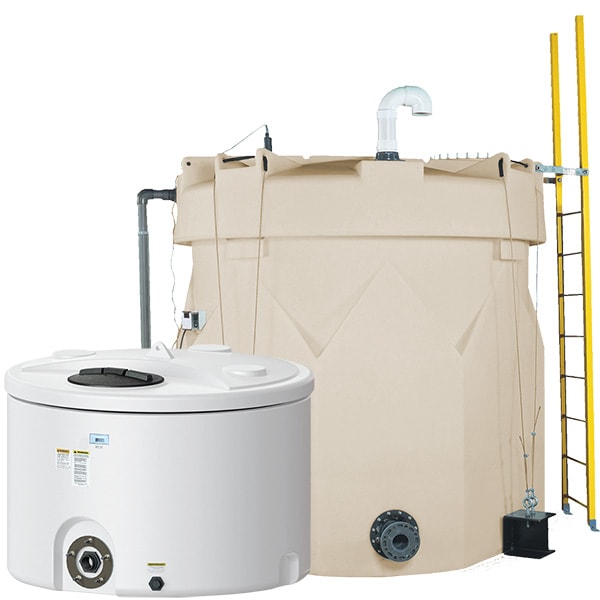
Protank Double Wall Tanks

A double wall tank is a tank-within-a-tank with a primary storage container enclosed by an integrated outer shell. The outer shell functions as a built-in secondary containment unit that catches leaks should the inner tank fail instead of reaching the workfloor, soil, or a drain. Choosing a double wall tank depends on the storage contents, which affects product resin type and specific gravity rating, and applicable codes, standards or legal requirements: SPCC, RCRA, fire code, insurer, or company policy, as each can set a different containment target. If these two are understood, the rest is tank-to-application configuration such as fittings, monitoring, and accessory components.

Tell us your chemical, concentration, temperature, and volume, and we can help match the resin, SG, and containment unit with a freight quote to your site.


How to Choose a Double Walled Plastic Tank

1. Resin & SG Selection

Double wall tanks are available in either linear HDPE (HDLPE) or crosslinked polyethylene (XLPE), in specific gravity ratings of 1.5 and 1.9, depending on the tank line and material. The rating must be matched to the density of the storage fluid, at minimum, (a 1.9 SG rated tank can handle roughly 15.8 lb/gal liquids). Resin choice is application-specific: XLPE offers higher environmental stress-crack and impact resistance, in general; HDLPE is weldable and can be modified to accommodate custom fittings.

For aggressive oxidizers, there are chemical-specific resin packages, including proprietary sodium hypochlorite (resin #880059), often UV-opaque to slow degradation, and sulfuric acid (resin #880046) formulations.

2. Containment Requirements by Rule

Secondary containment applies to more than one rule. Oil is governed by SPCC (40 CFR 112); hazardous waste tank systems by RCRA (40 CFR 264/265.193); hazardous materials generally by the IFC/IBC and your state fire code; and insurers or corporate EHS policy may establish its own rules. Each rule may set a different required containment volume and freeboard.

A satisfactory tank product depends on the liquid type and properties, total volume, site parameters, and often the approval of a PE or local governing body. A dual wall tank provides engineered secondary containment in one unit, supporting compliance, and an engineer can confirm it meets your company-specific obligation. We won’t tell you it makes you compliant; no honest vendor can.

3. Primary Volume & Footprint

Double wall storage tank capacities run 35 to 12,500 gallons. The benefit of a double walled tank over a single wall tank placed in a separate concrete dike is footprint: the containment is built-in, so one system can potentially be specified over engineering and pouring a basin around a tank.

4. Draw Configuration, Fittings, Accessories, and Freight

Double wall tanks can be configured with drains, fill lines, draw pipes, U-vent assemblies, OSHA rated ladders, tie-down systems / seismic restraints, level indicators, manways, and interstitial leak detectors.

For discharge, the double wall design requires a bottom outlet to pass through both walls using a through-containment fitting, or a top draw line. Sidewall bulkheads cannot be added the same way they would be on a single wall tank. Decide draw configuration before you order.

Always use flexible fittings as inner and outer walls expand and flex independently under hydrostatic load. Rigid piping tied to a through-containment fitting can shear pipes or crack nozzles, and typically voids tank warranty.

Double wall tanks also ship heavier and bulkier per gallon than single walled equivalents and may require a different freight class and offloading.

5. DWC vs. Captor Style Tanks

DWC series dual wall tanks come in 35–1,500 gallons, ideal for mini-bulk and day tanks; ≤250 gal options clear standard doorways. Forklift channels on 275, 360, and 500 gal. Captor tanks range from 550–12,500 gallons, ideal for bulk and tanker-fed uses; feature a U.F.O. fitting, 18” standard manway up to 24”, and add-on options for OSHA ladders, tie-down lugs, sensors, level indicators, fill/draw lines, and vent assemblies.

6. Used Oil Containment Tanks

Used oil tanks answer to 40 CFR 279.22, not the chemical-containment rules, and they’re built for it: safety-yellow secondary (black primary), 2” top-draw quick-connect for the hauler’s pump-out, hinged lockable manway, and a debris strainer/sink. Containment runs 110–115% (Snyder WOS) or 110% (Chem-Tainer Oil-Tainer). Browse used oil tanks for our full selection.

Double Wall Tank Spec & Logistics

Representative Sizes
Capacity Diameter × Height S.G. Rep. Part
35 gal 22″ × 36″ 1.9 DWS35
120 gal 34″ × 51″ 1.9 DWS120
500 gal 53″ × 81″ 1.9 DWS500
1,000 gal 81″ × 69″ 1.9 DWS1000
2,500 gal 102″ × 122″ DWS2500
5,000 gal 102″ × 216″ DWS5000
12,500 gal 142″ × 274″ DWS12500

Representative sizes; dimensions and ratings vary by model and manufacturer line.


Dual Wall Polyethylene Resins & Compliance Standards

Resin

HDLPE for weldability, customization capacity, and value on chemically compatible, non-critical, and water related applications. XLPE for roughly an order of magnitude more stress-crack resistance and higher impact strength on demanding chemical duty. Neither is universally better for all services. The right choice is a fluid-by-fluid determination, and for oxidizers, selection is specific per compatibility data. We evaluate your quote resin selection against verified data to ensure no validated concerns.

Specific gravity

Ratings of 1.5 and 1.9. Match tank SG rating to fluid density, minimum. Confirm chemical, concentration, activity, and temperature compatibility together as full application suitability and tank structural derating shifts with temperature. For example, a heated liquid with a 1.45 specific gravity may be better matched to a 1.9 SG tank over a 1.5 SG tank, especially when factoring in long term service.

ASTM D1998

Primary, vertical cylindrical tanks of 500 gallons or more are designed to meet or exceed ASTM D1998, the specification for one piece rotomolded polyethylene upright storage tanks in atmospheric service (Type I XLPE continuous service below 150°F, Type II HDLPE below 140°F). ASTM D1998 does not apply to the smaller day tank sizes or to non-cylindrical containment units. ASTM D1998 does not cover external, imposed loads like seismic or wind that are covered by local building codes and an engineer.

Containment

The outer shell is engineered to hold a defined percentage of the primary tank’s contents, commonly to bring the full containment capacity to 110% of the volume rating. This is a build specification, not a compliance certification. Whether a double wall tank satisfies SPCC, RCRA, or fire code obligations depends on the fluid, volume, jurisdiction, and professional sign-off. One practical advantage: because double wall tanks are fully enclosed, precipitation never enters the containment. This eliminates the concerns with open dikes that have to be sized with added freeboard for storm events and then pumped out after rainfall.

Features → applications

Integrated secondary containment (tank-in-a-tank)
Does the job of a dike in a single unit. EHS teams commonly choose these tanks to shrink containment footprint.
De-risk: we inform on the product; your engineer confirms sufficiency.
Fully enclosed outer wall
Keeps rain, snow, and debris out to protect product purity and keep containment unit from stormwater fill.
For: outdoor installs, water/wastewater chemical feed, anywhere open basins would collect precipitation or debris.
Interstitial (annular) space + leak detection
The gap between walls can be monitored visually or with a leak detection sensor to catch a primary wall failure before anything can reach the environment. Captor models can be fitted with 2” or 3” PVC sight glass assemblies.
For: regulated storage requiring early, rapid detection.
Through-containment fitting / draw design
Bottom outlets pass through both walls via a purpose built fitting; top draw is an alternative. Snyder’s Unified Fitting Outlet, 2”, 3”, and 4” with 6” only on the largest Captor tanks, ordered with an EPDM or Viton (FKM) gasket. Generic substitute parts can void the manufacturer’s warranty.
De-risk: decide plumbing before order.
Vented or non-vented manway
Vented manway is standard; non-vented is recommended where chemical fumes need to be routed away from the tank area.
 
Vent sizing (bulk sizes)
These are atmospheric tanks and cannot be pressurized. A vent sized for a pump fill can be dangerously undersized for a pneumatic, air-unloaded tanker delivery.
Verify vent sizing against your unloading method before use.
SG rating up to 1.9
Specifies the chemical weight the tank can carry.
For: dense and concentrated solutions.


Applications
Use case Typical fluids What to verify
Chemical storage & feed (water / wastewater, municipal, industrial) Sodium hypochlorite, sodium hydroxide, sulfuric acid, ferric chloride, polymers Resin + chemical-specific formulation; SG; compliance / containment driver (IFC / state)
Agricultural & deicing bulk liquids Liquid fertilizer, brine, calcium chloride, urea solutions SG (1.9 for dense brines); outdoor / indoor containment
Waste & used oil collection (fleet, automotive): WO/ODW models Used motor oil, waste oil Oil specific rules (40 CFR 279.22, SPCC 40 CFR 112)
Industrial process / day tanks / neutralization Process chemicals, pH adjustment Working volume; fittings; temperature compatibility


Logistics & freight

Double wall tanks ship fully assembled from our warehouse network either LTL or flatbed depending on size. They are heavier and larger per gallon of storage than a single wall tank of the same capacity, which affects freight class and handling. Plan for liftgate or forklift offload on larger units and confirm site access. We quote freight to your delivery point and flag offload requirements up front to eliminate surprises at receipt. Honest lead times by size on request.

Talk to a specialist about your chemical and containment requirement.If you know your liquid or chemical profile and jurisdiction requirements, we can help match the resin, SG, containment, and freight specifics.
Request a Custom Quote


Frequently Asked Questions about Double Wall Tanks

Yes, a doubled wall polyethylene tank provides engineered secondary containment in a single unit. The outer shell is built to capture a leak from the primary tank should it fail. Whether it satisfies specific regulatory obligations (SPCC under 40 CFR 112, RCRA under 40 CFR 264.193, or your state fire code) depends on the fluid, total volume, inspection routine, release response, and the sign off by an engineer or the authority having jurisdiction (AHJ). We can tell you what a given tank provides; compliance confirmation is your responsibility.

A double wall tank is built as two integral shells: an inner primary tank that holds the liquid, and an outer containment shell surrounding it. The gap between them, the interstitial, or annular, space, stays empty in normal service. If the primary wall fails, the liquid is captured in that space instead of reaching the floor or ground, and a leak detection sensor or sight glass is used to monitor the interstitial space for failure.

The outer containment shell is engineered to hold a percentage of the primary tank’s volume to bring total capacity up to 110% or more. The extra volume afforded by the secondary tank depends on the model: Captor tanks run 115-120%; used oil tanks run 110%; The Chem-Tainer DC series states compliance with the same capacity requirement without publishing a percentage: ask us for the figure on the specific model.

It depends on the chemical, its concentration, and temperature. XLPE offers higher stress crack and impact resistance; HDLPE is weldable and customizable. For oxidizers like sodium hypochlorite the choice is application specific and even different tank manufacturers disagree. Dedicated chemical resin packages exist such as HDLPE #880046 for sulfuric acid and HDLPE #880059 for sodium hypochlorite (bleach).

Double wall tanks range from 35 to 12,500 gallons. Specific gravity ratings of 1.5 and 1.9 are standard on the DCT and Captor models, with other ratings available on request. DWC series tanks do not have a published SG rating, so confirm suitability with us before choosing it for a dense fluid. Always match the SG rating to the density of the fluid to be stored; a 1.9 SG tank handles roughly 15.8 lb/gal, against water’s 8.34.

Yes, but it has to pass through both walls with a specialized through-containment fitting. Ordinary sidewall bulkhead fittings cannot be added as they can on a single-wall tank. Top draw assemblies can be installed as an alternative. Decide draw configuration before ordering.

Yes, dedicated double wall waste oil tanks are available (part series: WO and ODW). Used oil storage carries its own regulatory considerations: used-oil management rules 40 CFR 279.22 and, for oil, SPCC.


Related Products


Name Diameter Height Size S.G. Part
35 Gallon Double Wall Tank 24" 35" 24 Ø
35 H
DWC35
35 Gallon Double Wall Tank 22" 36" 22 Ø
36 H
1.9 DWS35
50 Gallon Double Wall Tank 26.5" 38" 26.5 Ø
38 H
DWC50
60 Gallon Double Wall Tank 26" 41" 26 Ø
41 H
1.9 DWS60
65 Gallon Double Wall Tank 28" 37" 28 Ø
37 H
DWC65
100 Gallon Plastic Waste Oil Tank 35" 41" 35 Ø
41 H
WOC100
100 Gallon Double Wall Tank 35" 39" 35 Ø
39 H
DWC100
120 Gallon Double Wall Tank 34" 51" 34 Ø
51 H
1.9 DWS120
120 Gallon Double Wall Tank 33" 45" 33 Ø
45 H
DWC120
120 Gallon Plastic Waste Oil Tank 33" 51" 33 Ø
51 H
1.9 WOS120
150 Gallon Plastic Waste Oil Tank 34" 49" 34 Ø
49 H
WOC150
150 Gallon Double Wall Tank 34" 62" 34 Ø
62 H
1.9 DWS150
150 Gallon Plastic Waste Oil Tank 34" 62" 34 Ø
62 H
1.9 WOS150
150 Gallon Double Wall Tank 34" 48" 34 Ø
48 H
DWC150
200 Gallon Plastic Waste Oil Tank 41" 53" 41 Ø
53 H
WOC200
200 Gallon Double Wall Tank 41" 52" 41 Ø
52 H
DWC200
250 Gallon Double Wall Tank 34" 83" 34 Ø
83 H
1.9 DWS250
275 Gallon Double Wall Tank 47" 63" 47 Ø
63 H
1.9 DWS275
275 Gallon Plastic Waste Oil Tank 47" 63" 47 Ø
63 H
1.9 WOS275
300 Gallon Plastic Waste Oil Tank 57" 45" 57 Ø
45 H
1.9 ODW0300
350 Gallon Double Wall Tank 52" 56" 52 Ø
56 H
DWC350
360 Gallon Double Wall Tank 53" 63" 53 Ø
63 H
1.9 DWS360
360 Gallon Plastic Waste Oil Tank 53" 63" 53 Ø
63 H
1.9 WOS360
385 Gallon Plastic Waste Oil Tank 64" 40" 64 Ø
40 H
WOC385
405 Gallon Double Wall Tank 48" 73" 48 Ø
73 H
1.9 DWS405
405 Gallon Plastic Waste Oil Tank 48" 73" 48 Ø
73 H
1.9 WOS405
500 Gallon Double Wall Tank 59" 71" 59 Ø
71 H
DWC500
500 Gallon Plastic Waste Oil Tank 57" 69" 57 Ø
69 H
1.9 ODW0500
500 Gallon Plastic Waste Oil Tank 53" 81" 53 Ø
81 H
1.9 WOS500
500 Gallon Double Wall Tank 53" 81" 53 Ø
81 H
1.9 DWS500
550 Gallon Double Wall Tank 76" 65" 76 Ø
65 H
1.9 DWS550
750 Gallon Plastic Waste Oil Tank 73" 67" 73 Ø
67 H
1.9 WOS750
750 Gallon Double Wall Tank 73" 67" 73 Ø
67 H
1.9 DWS750
1000 Gallon Plastic Waste Oil Tank 81" 69" 81 Ø
69 H
1.9 WOS1000
1000 Gallon Double Wall Tank 81" 69" 81 Ø
69 H
1.9 DWS1000
1000 Gallon Double Wall Tank 74" 85" 74 Ø
85 H
DWC1000
1100 Gallon Double Wall Tank 76" 104" 76 Ø
104 H
1.9 DWS1100
1500 Gallon Double Wall Tank 93" 76" 93 Ø
76 H
1.9 DWS1500
1550 Gallon Double Wall Tank 76" 136" 76 Ø
136 H
1.9 DWS1550
2000 Gallon Double Wall Tank 102" 103" 102 Ø
103 H
1.9 DWS2000
2500 Gallon Double Wall Tank 102" 122" 102 Ø
122 H
1.9 DWS2500
3000 Gallon Double Wall Tank 102" 142" 102 Ø
142 H
DWS3000
3500 Gallon Double Wall Tank 102" 158" 102 Ø
158 H
DWS3500
4000 Gallon Double Wall Tank 102" 178" 102 Ø
178 H
DWS4000
4500 Gallon Double Wall Tank 102" 197" 102 Ø
197 H
DWS4500
5000 Gallon Double Wall Tank 102" 216" 102 Ø
216 H
DWS5000
5500 Gallon Double Wall Tank 120" 172" 120 Ø
172 H
DWS5500
6500 Gallon Double Wall Tank 120" 199" 120 Ø
199 H
DWS6500
8700 Gallon Double Wall Tank 142" 197" 142 Ø
197 H
DWS8700
10000 Gallon Double Wall Tank 142" 226" 142 Ø
226 H
DWS10000
12500 Gallon Double Wall Tank 142" 274" 142 Ø
274 H
DWS12500