
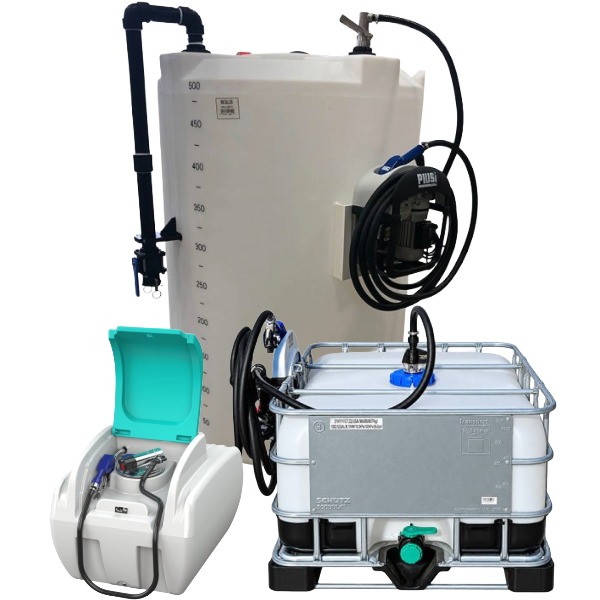
DEF tanks are used to dispense, store, or transport diesel exhaust fluid (AUS 32 urea solution) needed for vehicles and equipment with selective catalytic reduction (SCR) diesel engines. Commonly known as DEF storage tanks, DEF transfer tanks, and DEF totes, they range from portable pump units designed for truck beds and trailers to mini-bulk dispensing stations for resupplying fleets. DEF is a 32.5% solution of automotive grade urea in purified water that must meet ISO 22241 purity standards for limited trace contaminants. To meet and maintain these purity requirements, the storage tank and any attached fittings, gaskets, hoses, pumps, and nozzles all have to be DEF compatible.
Choosing a DEF tank depends on six working details:
The tank design and how the DEF is dispensed
Total capacity needed and usage capability within DEF's shelf life
Storage location and temperature exposure
Compatibility of every wetted part
Specification of single or double wall construction
The pump power and dispensing hardware the job or site needs
A DEF tank lowers the per gallon cost of DEF, removes trips to a gas station, truck stop, or store, and keeps supply in a closed, dispense ready system right where the equipment that needs it operates. Protank offers portable DEF transfer tanks and DEF IBC totes in capacities from 25 to 330 gallons, single wall mini-bulk tanks from 500 to 5,150 gallons, and double wall mini-bulk DEF tanks from 500 to 3,000 gallons.
DEF tanks are grouped by mobility and easy transport capability or stationary placement. This design determines whether a tank can be carried by hand, moved by forklift, or must be installed as a fixed dispensing station. All available DEF tank systems ship as complete, ready-for-use products with a hose, nozzle, suction line, pump, and power connection.
Portable DEF transfer tanks
Portable DEF transfer tanks range from 25 to 116 gallons and are built to ride in the bed of a pickup, on a trailer, or on the back of a UTV. They feature an enclosed, lockable pump compartment, a diaphragm pump, a 13 foot (58/116gal) or 20 foot hose, and an automatic shut off dispensing nozzle. Handgrip handles are molded into these tanks for lifting and positioning when empty. When full, these tanks will weigh roughly 250 to 1,200 lbs.
Common uses: site refueling of construction and earthmoving equipment; field supplying working agricultural equipment; service trucks at remote job sites; small fleets without a fixed dispensing station.
Portable DEF transfer tanks are the right choice when DEF has to travel to the equipment rather than having the equipment come to a fueling point.
DEF IBC totes
DEF IBC totes are caged composite totes with a DEF rated transfer pump and come in 135, 275, and 330 gallon sizes. They feature a translucent polyethylene tank in a galvanized steel cage on a pallet base with 4 way fork channels for handling with pallet jacks or forklifts. Each tote ships with a cage mounted DEF pump in either 12 volt DC with battery clamps or 120 volt AC with a plug-in cord. The pump provides up to 9 GPM flow rate through a 20 foot delivery hose and automatic shut-off nozzle. The pump draws through a top-mounted dispense coupler on a closed-system valve, so stored DEF is not exposed to open air during use.
Upgrade options add a metered nozzle with digital readout, or a metered nozzle with an in-line filter to catch any potential particulate contamination. The pump runs on a 20 minute duty cycle to prevent overheating and damage. The IBCs have a bottom discharge valve to allow gravity draining.
Common uses: shop and service bay dispensing; dealer and fleet yards; moving DEF between work areas; construction sites; agricultural operations and seasonal farms; staging DEF near equipment in a standard IBC footprint.
DEF IBC totes are the right choice when DEF usage exceeds portable tanks but beneath a mini-bulk tank, and portability still matters. Choose tote size to match turnover and handling capabilities if the tote will be moved when full.
Mini-bulk DEF dispensing tanks
Mini-bulk DEF tanks are vertical dispensing tanks that range from 500 to 5,150 gallons, 48 to 102 inches in diameter, and 68 to 161 inches tall. Single wall models include the full size range, and double wall models are available from 500 to 3,000 gallons. Mini-bulk DEF tanks are installed as a fixed dispensing station to service trucks, equipment, or portable transfer tanks, and are resupplied by bulk delivery.
Common uses: fleet yards and truck terminals; municipal fleet garages; equipment dealers; agricultural co-ops and large farm operations; bulk supply for refilling smaller totes and portable tanks used in mobile duty.
Mini-bulk DEF tanks are the right choice when a site or business uses enough DEF to justify bulk delivery and a fixed dispensing point.
2. Capacity and Shelf Life
The DEF tank size needed depends on total consumption between fresh deliveries and how much DEF will be dispensed before its service life expires. DEF has a limited shelf life that shortens with rising storage temperature and direct sunlight exposure. On sites with extended high ambient temperatures, a tank that has been sized for several months of DEF provision can end up holding fluid past its usable shelf life if all variables are not properly considered.
Storage needs above 5,150 gallons typically use multiple tanks or bulk underground storage tanks. Tell us your total volume and service needs, and we can help direct you to the right DEF storage and dispensing system.
3. Storage Location and Temperature Exposure
The location a DEF tank is installed or kept has a direct effect on how long the fluid stays in specification. DEF breaks down over time, and faster at elevated temperatures. Indoor, controlled environment storage is preferred for all diesel exhaust fluid containers if possible. When a tank must be kept outside, the climate influences other site needs or recommendations:
Outdoors in direct sun: storage tanks with opaque walls or dual wall designs limit DEF UV exposure, and a roof, building, or natural shade over the tank limits solar heat gain. Lighter tank colors also absorb less heat.
Outdoors in sustained heat: polyurethane foam insulation with a weatherproof mastic coating can significantly slow heat transfer into the tank during daytime sun hours and help maintain stable storage conditions. See Heat Traced and Insulated Tanks.
Outdoors in sustained freezing: heat tracing, insulation, or IBC tote heat blankets can be used to keep DEF above its freezing point.
Underground: below grade storage provides stable temperatures and zero sunlight exposure. Underground DEF storage is typically done in Fiberglass Tanks specified for DEF service.
4. Wetted Part Compatibility
DEF compatibility applies to every wetted part: the tank, fittings, gaskets, hoses, pumps, and nozzles. Incompatible metals can corrode with DEF exposure and release ions that exceed ISO 22241 limits. Such contamination can put a batch out of spec and cause damage to the SCR catalyst system the fluid is dispensed into.
Materials commonly used in DEF tank systems:
Tanks: high density polyethylene (HDPE)
Fittings and bulkheads: polypropylene, 316 stainless steel, PVDF
Gaskets: EPDM, FKM, PTFE
Bolts and hardware: 316 stainless steel
Hoses: EPDM
Pumps and nozzles: engineered plastics, 316 stainless steel wetted parts
Materials not recommended for wetted diesel exhaust fluid service include copper, brass, aluminum, carbon steel, and zinc coated galvanized steel. Protank's DEF dispenser tank systems ship with pumps, fittings, and nozzles built from DEF compatible materials listed in ISO 22241-3. Parts replaced in the field during normal service wear must meet the same standard because a single wetted brass or galvanized part can contaminate the entire DEF stock and cause catalytic damage or injector system clogs and failures.
5. Single or Double Wall DEF Tanks
Single wall DEF tanks are standard, rotomolded HDPE containers with translucent walls and external gallonage markers. Double wall DEF tanks are engineered with a primary tank enclosed inside a second polyethylene wall. This tank-within-a-tank design has the double benefit of capturing leaks should the inner tank fail and adds a barrier against sunlight and heat gain in DEF storage applications.
Double wall mini-bulk DEF tanks are available from 500 to 3,000 gallons with a 1.7 SG rating. Whether secondary containment for diesel exhaust fluid is mandatory for your specific site is set by state and local rules or by company policy. Bulk DEF storage requirements should be confirmed before choosing a single or double wall tank.
6. Pump Power and Dispensing Hardware
Portable DEF tanks run on 12 volt DC with battery clamps for remote use that can run on vehicle or battery power. Mini-bulk kits run on 120 volt AC for shops and yards. DEF IBC totes come in either 12 volt DC or 120 volt AC with a standard electrical plug for outlets or portable generators. The 12V DC pumps draw up to 22 amps and should be run with the engine running if powered by a vehicle battery.
DEF pump flow rates reach up to about 9 GPM, and automatic shut off nozzles are standard to prevent overfilling and overflow events. Mini-bulk kits include a digital flow meter. DEF totes offer a metered nozzle or a metered nozzle plus in-line filter options. DEF flow meters are recommended for fleets or businesses that track or bill back DEF use.
DEF Tank Specifications
Mini-Bulk DEF Tank Dimensions
Capacity
Dimensions (D × H)
Wall
SG
Part #
500 gal
48″ × 68″
Single
1.9
VDEF500
500 gal
57″ × 69″
Double
1.7
DWDEF500
750 gal
48″ × 103″
Single
1.9
VDEF750
1,000 gal
64″ × 80″
Single
1.5
VDEF1000
1,000 gal
77″ × 82″
Double
1.7
DWDEF1000
1,500 gal
64″ × 116″
Single
1.5
VDEF1500
1,500 gal
77″ × 119″
Double
1.7
DWDEF1500
2,000 gal
102″ × 97″
Double
1.7
DWDEF2000
2,100 gal
87″ × 89″
Single
1.5
VDEF2100
2,500 gal
90″ × 103″
Single
1.7
VDEF2500
2,500 gal
102″ × 119″
Double
1.7
DWDEF2500
3,000 gal
90″ × 120″
Single
1.7
VDEF3000
3,000 gal
102″ × 141″
Double
1.7
DWDEF3000
4,200 gal
96″ × 148″
Single
1.7
VDEF4200
5,150 gal
102″ × 161″
Single
1.7
VDEF5150
Portable and IBC DEF Tank Dimensions
Capacity
Dimensions (L × W × H)
Format
SG
Part #
25 gal
31″ × 27″ × 19″
Portable
1.9
25DEF
55 gal
31″ × 27″ × 29″
Portable
1.9
55DEF
58 gal
36″ × 24″ × 24″
Portable
*
58DEF
75 gal
51″ × 21″ × 31″
Portable
1.9
75DEF
100 gal
47″ × 34″ × 34″
Portable
1.9
100DEF
116 gal
48″ × 31″ × 30″
Portable
*
116DEF
135 gal
48″ × 40″ × 27″
IBC tote, 12V or 120V
1.9
IBCDEF135 series
275 gal
48″ × 40″ × 46″
IBC tote, 12V or 120V
1.9
IBCDEF275 series
330 gal
48″ × 40″ × 53″
IBC tote, 12V or 120V
1.9
IBCDEF330 series
*Specific gravity rating not printed; product designed specifically for diesel exhaust fluid (DEF)
DEF Tank Models
Model
Capacities
Pump power
Handling
Selection details
Portable transfer tank
25–116 gal
12V DC, battery clamps
Truck or trailer bed; UTV (smaller sizes)
Lift handles or pallet jack base by model; lockable pump compartment; 13 to 20 ft hose
IBC tote
135–330 gal
12V DC or 120V AC
4 way forklift, pallet jack
Galvanized steel cage; closed system top draw; optional metered nozzle or meter + filter
Mini-bulk, single wall
500–5,150 gal
120V AC
Fixed install
Sized for bulk delivery; pump kit with digital meter and filter
Mini-bulk, double wall
500–3,000 gal
120V AC
Fixed install
Integrated secondary containment; same pump kit
All pumps deliver up to ~9 GPM and feature an automatic shut-off nozzle.
DEF Tank Materials, Standards & Compliance
Polyethylene Construction and SG Rating
DEF tanks are made from high density polyethylene (HDPE), a synthetic thermoplastic. HDPE is unaffected by urea solutions and does not rust, corrode, or shed metal ions into stored DEF, even over long term use. Polyethylene is a common use material for DEF storage and is frequently used for the on-board fluid reservoirs of SCR equipped vehicles. The resin includes UV inhibitors to help protect the tank and its contents from sunlight.
Specific gravity ratings on DEF tanks range from 1.5 to 1.9 by model. The SG rating describes the weight of liquid the tank wall is engineered to hold. Diesel exhaust fluid (AUS 32) has a specific gravity of approximately 1.09, meaning these tanks provide a wide structural safety margin.
ISO 22241 and DEF Purity
ISO 22241 is the international standard for AUS 32 diesel exhaust fluid. Part 1 sets quality and purity requirements. Part 3 covers handling, transportation, and storage, including recommended materials and shelf life.
ISO 22241-1 purity limits are measured in milligrams per kilogram, or parts per million by weight. Copper, zinc, nickel, and chromium are limited to 0.2 mg/kg, and aluminum, iron, calcium, magnesium, sodium, and potassium to 0.5 mg/kg. At these limits, a single tablespoon of table salt can add enough sodium to contaminate and put more than 3,000 gallons of DEF out of spec and unfit for use.
A tank intended for diesel exhaust fluid should be new or used only for certified DEF. Tanks, hoses, and pumps previously used for fuel, oil, water, or other chemicals can carry residue and minerals capable of contaminating DEF stock. If cleaning or flushing is needed following use, DEF equipment should be rinsed with fresh DEF, deionized (DI) water, or distilled water only, never tap water. Fill lids and bungs should be kept closed except when needed for transfer, refilling, or inspections.
Shelf Life and Storage Temperature
DEF shelf life is determined by storage temperature and sunlight exposure heating as they directly affect DEF stability and strength. Expected minimum shelf life by sustained storage temperature:
50°F or below: 36 months
50 to 77°F: 18 months
77 to 86°F: 12 months
86 to 95°F: 6 months
Above 95°F: test before use
Heat and heating from sunlight causes the urea in DEF to break down (hydrolyze) into ammonia. This irreversibly lowers DEF concentration from the standardized 32.5% urea, 67.5% water solution. An open or poorly sealed DEF tank can also lose water to evaporation, which raises urea concentration and can leave crystal deposits at nozzles and inside the SCR system. Either activity can shift DEF outside the 31.8 to 33.2% urea range the systems are calibrated for.
DEF freezes at 12°F (-11°C). Freezing and thawing do not affect DEF quality, but frozen or semi-frozen DEF cannot be pumped. Let the tank thaw completely before dispensing, and avoid direct or concentrated heat.
When the urea in DEF breaks down, it releases ammonia gas that can build pressure in a sealed container. Vented fill caps or manways, by model, help accommodate this offgassing, particularly in bulk DEF stores kept for a year or more. Vents should be kept clear and free of debris.
Containment and Regulatory
Diesel exhaust fluid is non-flammable and non-hazardous under DOT shipping regulations. It is not classified as an oil under the EPA's Spill Prevention, Control, and Countermeasure (SPCC) rule 40 CFR 112, so federal oil and spill containment requirements don't apply to diesel exhaust fluid. Whether a DEF tank needs containment is instead set by state and local codes, fire officials, or facility policy, and can depend on tank size and site location. Many sites choose double wall tanks regardless to keep spills out of storm drains and protect their DEF inventory. Confirm containment and permitting requirements with your local authority or jurisdiction.
DEF Tank Features → Applications
Complete Pump and Dispense Systems
Portable and IBC DEF tanks ship fully assembled with the pump, hose, and nozzle installed. Mini-bulk DEF tanks ship as complete kits with a DEF dispensing system: diaphragm pump, digital flow meter, in-line filter, automatic nozzle, suction and 20 ft delivery hoses, and down tube, container valve, and coupler to match tank configuration. This keeps field-sourced plumbing and incompatible metals out of the DEF system during first fill and use.
Ideal for: fleets and contractors that need a dispense ready DEF supply tank; sites without a technician to plumb a tank.
De-risk: attach or replace hoses, nozzles, and fittings only with DEF compatible parts.
Opaque, UV Inhibited Tank Walls
Opaque polyethylene with UV inhibitors limits the amount of sunlight that can reach stored DEF and protects the plastic tank wall from sun damage. For outdoor dispensing, portable and double wall mini-bulk DEF tanks have rigid opaque walls that block sun intrusion better than translucent tank models.
Ideal for: outdoor field dispensing; permanent, stationary refill sites; exterior installations without shelters or shade.
De-risk: UV inhibitors and opaque tank walls do not eliminate heat gain. Add shade, insulation, or consider indoor storage when outdoor temperatures stay above 86°F.
Enclosed, Lockable Pump Compartment
The pump, valves, and nozzle on portable DEF tanks sit inside an enclosed compartment with a lid that can be closed when not in use and locked.
Ideal for: truck and UTV bed transport; unattended job sites; equipment yards with shared access.
De-risk: keep the compartment closed during transport or when sitting idle to keep dust and debris out of the dispensing hardware.
Forklift Channels and Steel IBC Frames
IBC totes for DEF have cross-directional access channels for pallet jack or forklift handling from any side. Each has a blow-molded polyethylene container supported within a steel frame and carries the UN/DOT 31HA1/Y design rating.
Ideal for: moving DEF between work areas; refilling from bulk supply; dealer and service shop dispensing.
De-risk: keep the fill port closed and secure the tote during transport.
Double Wall Construction
Double wall mini-bulk DEF tanks are built with the primary tank inside an outer containment tank. The double wall design provides an extra barrier against sunlight and heat transfer that helps keep DEF stable for longer, potentially increasing fluid shelf life.
Ideal for: sites near floor drains or waterways; businesses with secondary containment policies; jurisdictions that require containment.
De-risk: double wall construction does not by itself guarantee compliance with containment requirements. Confirm any jurisdictional regulations.
Mini-Bulk Storage Volume
Mini-bulk DEF tanks hold 500 to 5,150 gallons in a single vertical container measuring 4 to 8.5 feet in diameter. Larger liquid DEF volumes require more time or more thermal energy to increase total storage temperatures. This makes them more resistant to heat than small containers and helps stored DEF tolerate daily temperature swings.
Ideal for: fleet yards and truck terminals; municipal garages; sites resupplied by bulk delivery.
De-risk: confirm offload equipment and overhead clearance at the install location before delivery.
DEF Tank Applications
Application
Typical tank format
What drives selection
Trucking fleet yard or terminal
Mini-bulk
Use between deliveries; bulk delivery access; indoor or shaded location
Municipal fleet garage
Mini-bulk, single or double wall
Containment policy; indoor placement; storage capacity vs consumption
Construction and earthmoving
Portable, IBC tote
Transport to equipment; lockable pump compartment; outdoor heat exposure
Agriculture
Portable, IBC tote
Seasonal use vs shelf life; field refueling; winter storage
Equipment dealer or service shop
IBC tote, small mini-bulk
Dispense volume per bay; 120V power; forklift handling
Remote job site
Portable
12V power; truck or UTV transport; heat exposure
The applications above represent common use cases and should not be taken as approval of suitability or a replacement for an independent assessment.
DEF Tank Freight & Delivery Logistics
DEF tanks ship from the warehouse or factory that holds the specific product model and nearest to your delivery location. Current FOB points include Texas, Mississippi, and Florida, so lead time and freight cost vary with the part number. DEF tank systems ship ready for deployment and use.
Liftgate service is typically not available on large freight that exceeds 83 inches in any single dimension, which includes all mini-bulk DEF tanks above 500 gallons. Plan on having a forklift or other offload equipment available. Inspect tanks on receipt and note damage on the delivery receipt before the driver leaves.
Ready to Purchase a DEF Tank?Request a quote or talk with one of our DEF tank specialists. Tell us your typical DEF use, indoor or outdoor storage plans, available power source at the dispensing location, and any secondary containment requirements. We can help match a DEF tank and dispensing system to the application and confirm expected freight times.
For most fleets, farms, and job sites that use DEF weekly, yes. Bulk DEF typically costs less per gallon than packaged DEF, refilling on the site eliminates trips to a truck stop or store, and a closed dispensing system keeps the fluid clean and results in less waste from empty containers. Systems with a metered pump also let you track DEF use by vehicle or job for reports, budgets, and optimization. If your use is low enough that a tank wouldn't empty within DEF's shelf life at your storage temperature, jugs may still be the better choice. Tell us your weekly use, and we can help you decide whether bulk makes sense.
A DEF tank should be sized according to your use between deliveries or refills, plus a reserve, but no larger than what you expect to use within DEF's shelf life at the average storage temperature. At or below 77°F, shelf life reaches up to 18 months of use. In hot climates averaging above 77°F, DEF storage life drops to 6–12 months. Portable tanks (25 to 116 gal) suit daily field top-offs, IBC totes (135 to 330 gal) suit weekly shop use, and mini-bulk tanks (500 to 5,150 gal) suit sites taking bulk deliveries and are often used alongside portable DEF tanks.
No, DEF equipment should be new or used only for certified DEF. The only suitable secondhand or refurbished container for DEF is one previously used for DEF. Fuel, oil, and water leave residue and minerals that can contaminate DEF and create an off-spec solution. Even a container that only held water before can contain residual minerals. Fuel transfer pumps and hoses often have brass, aluminum, or steel wetted parts that corrode in DEF and release metal ions capable of ruining DEF stock. To prevent damage or clogs to vehicle systems, diesel exhaust fluid must be pure. Only use pumps, hoses, and fittings built for DEF service. For cleaning, rinse with DEF or demineralized water only, never tap water.
It depends on storage temperature and amount of sun driven heating. ISO 22241-3 sets minimum DEF shelf life at 18 months when kept at or below 77°F, 12 months at or below 86°F, and 6 months at or below 95°F. Above 95°F, DEF should be tested before use. To extend DEF service life, keep tanks out of direct sun, rotate stock first-in, first-out, and check older or heat exposed DEF with a DEF refractometer. In-spec DEF will read 31.8–33.2% urea.
Yes, with planning for heat, cold, and sunlight. Indoor storage is preferred. For outdoor DEF tanks, set the tank on a level pad with delivery truck access and near a power source for the pump. For heat and sun protection, opaque walls are best and tanks should be kept in shade or under a structure. In regions with high, sustained summer temperatures, consider insulation for bulk tanks. In freezing climates, heat tracing, insulation, or tote heat blankets keep DEF dispensable. For below grade storage, see Fiberglass Tanks.
At-spec DEF freezes around 12°F and thaws without loss in quality, concentration, or usability because the water and urea freeze and melt together. Frozen or icy DEF cannot be pumped. Stock is recommended to be thawed completely before dispensing. Don't use direct or concentrated heat to speed thawing, as hot spots can break down urea, reduce DEF strength, and, if enough of it happens, can take the solution out of spec.
The primary difference is the dispensing system built into the tank. Both are typically HDPE. A DEF tank ships with DEF compatible fittings, gaskets, hose, pump, and nozzle. A new poly tank fitted only with DEF compatible hardware can be used to hold diesel exhaust fluid, but a DEF system arrives ready to dispense without having to buy and set up parts.
No, on-road and off-road vehicles and equipment use AUS 32, a 32.5% urea solution standardized under ISO 22241 and sometimes referred to as transit DEF. Marine DEF is AUS 40, a 40% solution under ISO 18611, used for SCR systems built for IMO Tier III. The two types aren't interchangeable, and the fluid your engine's SCR system specifies should always be used. AUS 40 uses the same DEF compatible tank and wetted materials, so if you're stocking AUS 40 shoreside, tell us on your quote so we can confirm pump and component compatibility.