Your browser is not supported. For the best experience, you should upgrade to a modern browser with improved speed and security.

Custom Blending and Mixing Tanks

Chemical blending, dilution, polymer preparation and activation, and slurry suspension all depend on keeping a batch moving. A solution left still separates, stratifies, or drops its solids to the tank floor; the result: batches that are inconsistent, incomplete, or unusable.

Solution tank agitation is typically achieved in one of three ways:

  • Overhead mixers and rotating impellers.
  • Recirculation loops pulling and returning solution.
  • Air sparging for gaseous agitation from below.

Each blending option puts load somewhere. An overhead mixer hangs weight, torque, thrust, and a bending moment off the tank top. A recirculation loop requires structural penetrations in the wall, and air sparging can add additional pipe weight. A tank that was not built to carry the load can experience: a flexing top that cracks around the mount, a side bulkhead that works loose and tears out, a mount that deflects and pulls the mixer shaft out of alignment.

The fix is a tank built around the agitation it will run, with wall thickness, reinforcement, mounting, and penetrations to match the load. Protank builds custom blending and mixing tanks to your work specifications, in polypropylene through PVDF, built in-house, made in the USA, and delivered nationwide.

Send us your specs for a free quote from Protank’s fabrication team, or see what we build below.
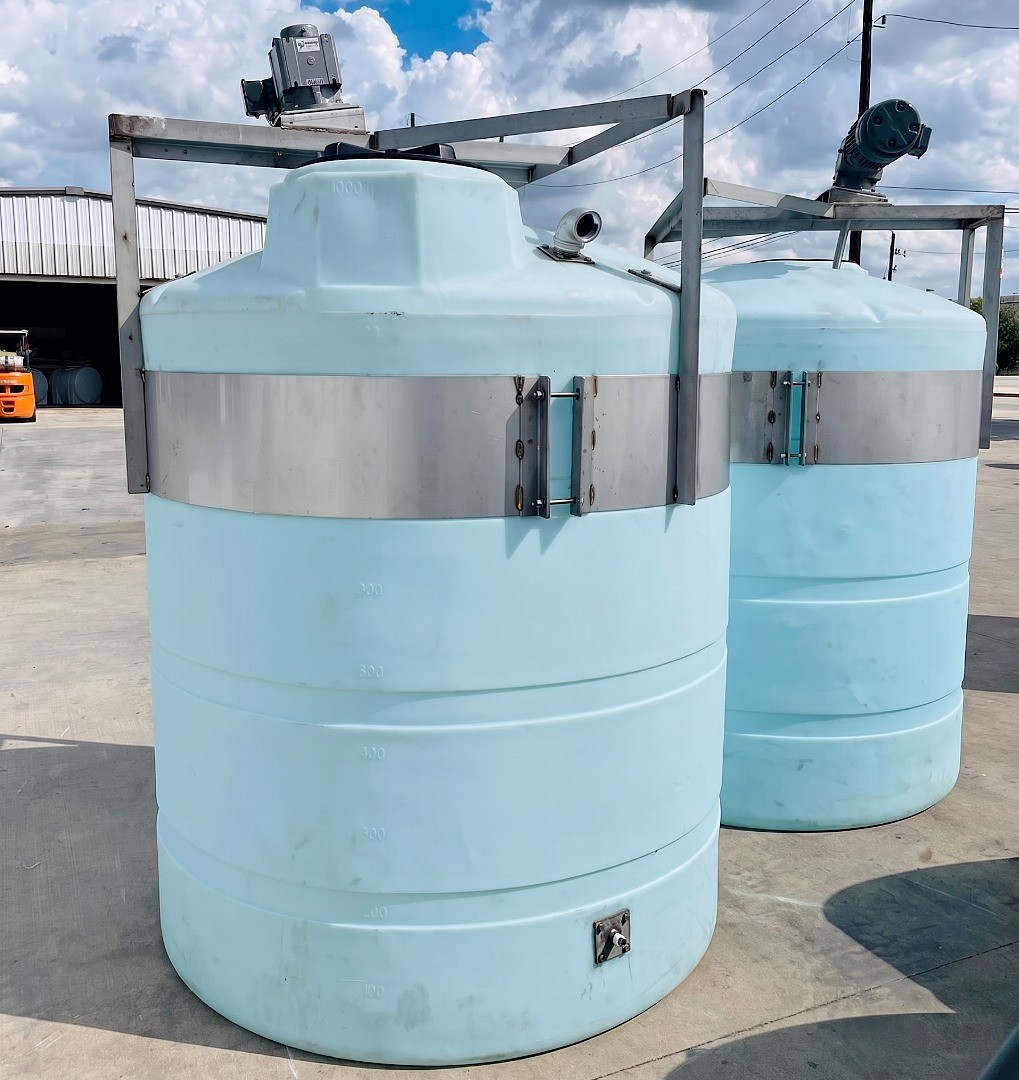
Two vertical polyethylene tanks with steel reinforcement bands and top mounted mixers for industrial agitation and blending
1–3 Day Response Nationwide Delivery PP / PVC / CPVC / HDPE / PVDF Mixer Rated Mounting Welded-In Baffles

Custom Blending & Mixing Tanks Built to Spec

Protank builds custom blending and mixing tanks made to your specifications and agitation method. Commonly requested by chemical formulators and blenders, coatings and adhesives producers, fertilizer and ag chemical operations, water treatment plants running polymer and dry chemical make-down, and biofuel and distillery operations. Backed by 20+ years of custom tank fabrication experience.

Tanks are made-to-order, with the customization options to match the solution being blended, specific gravity, operating temperature, batch volume, and the mixing equipment to be installed. Wall thickness and structural reinforcement are available when needed per mixer load, solution SG, and thermal load stress. Mounting setups are built to your equipment specifics. Internal baffles, recirculation penetrations, and air sparging lines are fabricated in place rather than retrofitted. Single blending tanks, activation and holding pairs, and multi tank batch setups are all options. Every tank is hydrostatically leak tested before it ships and arrives ready to integrate.

Typical Build Spec
Primary materialPolypropylene (PP-H)
Tank materialsPP · PVC · CPVC · HDPE · PVDF
PP service temp180°F cont.
Sheet thickness3/16″ – 1″
AgitationMixer · Recirc · Sparge
BafflesVertical · Cross
ReinforcementPP-encased steel
WeldingBead · Extrusion
ScaleUp to ~3,500 gal

How Blending & Mixing Tanks Are Used

A mixing tank completes the route from chemicals received to the solution the process actually uses. When concentrate arrives in IBC totes (product link), drums, or bulk, and chemicals arrive in bags or supersacks, they don’t go into processes as delivered. It gets added to a tank, brought to strength or mixed to spec, and then held or transferred to the point of use.

Most blending runs as a single tank or as a blend-and-hold pair. Batches are usually made in one vessel and drawn from another so mixing and dispensing do not compete for the same tank.

Step 01
Charge
Concentrate, dry chemical, or raw material is added to the tank from totes, drums, bags, or bulk.
Step 02
Blend
The batch is agitated to concentration and held uniform, by overhead mixer, recirculation, or air sparge.
Step 03
Hold or Transfer
Finished solution is drawn off to the point of use, or held in a second vessel for dispensing.

Protank’s specialty is the container and the setup built into it: the tank, its size, shape, slope and drainage, sumps, ports, bulkheads, gaskets, and valves, mixer mounting and structural reinforcement, welded internal baffles, recirculation and sparge penetrations, monitoring add-ons, and secondary containment. Mixers, blowers, pumps, controllers, and instrumentation are typically client supplied if beyond our catalog. Bring the equipment and its load and connection requirements, and Protank builds the tank to carry them.

We do not provide stamped engineering calculations. We build from your drawings, STEP files, datasheets, and dimensional specifications, and reinforce to the load they describe. Where a detail is unspecified, we can recommend an approach for your approval before proceeding. (See also: Custom Day Tanks & Dosing Tanks.)
Commonly Blended Chemicals

Sodium Hydroxide
PP-H
FormulaNaOH
Also calledCaustic soda
Batch taskDilution · make-up
Delivered at 50% and diluted to working strength, or dissolved from dry bead and flake. Dilution releases heat, so batches often run warm. Polypropylene carries caustic to 180°F continuous and is the economical choice across that range.
Absorbs carbon dioxide from an air stream; confirm before selecting air sparge.
Polymer
HDPE · PP
TypePolyacrylamide
FormDry · emulsion
Batch taskMake-down · activation
Dry or emulsion polymer charged, wetted, and mixed until fully hydrated before it reaches a feed pump. Non-corrosive, so tank demand is on mixing energy and residence time rather than chemical resistance.
Make-down and aging tank replacement pairs are common.
Sulfuric Acid
PVDF · PP
FormulaH₂SO₄
Delivered93% · 98%
Batch taskDilution
Diluted from concentrate to working strength. Dilution is strongly exothermic and batch temperatures rise well above ambient. Concentrated sulfuric is an oxidizer and often handled in PVDF or sourced steel; dilute solutions in polypropylene.
Specific gravity 1.84 at 98% means batch weight drives wall thickness and reinforcement.
Sodium Hypochlorite
CPVC
FormulaNaOCl
Also calledBleach
Batch taskDilution · feed prep
Delivered at 10 to 12.5% and diluted for disinfection feed. A strong oxidizer that degrades with heat, light, and time, offgassing oxygen. CPVC is commonly specified for hypochlorite service where polypropylene is a poor match.
Offgassing drives vent sizing; opaque walls limit light degradation.
Ferric Chloride
PP · CPVC
FormulaFeCl₃
Delivered35% – 45%
Batch taskDilution · coagulant feed
Coagulant delivered as concentrate and diluted for feed. Acidic and aggressive toward metals, so exposed hardware, fasteners, and any uncoated reinforcement are vulnerable rather than the tank wall itself.
Stains permanently; expect discoloration on light colored tank walls.
Lime Slurry
PP-C · HDPE
FormulaCa(OH)₂
Also calledHydrated lime
Batch taskSlurry make-down
Dry hydrated lime made down into slurry for pH adjustment. Abrasive, scaling, and quick to settle, so agitation runs continuously and tanks see heavy mechanical wear over time. Copolymer polypropylene is better suited to the abrasion concerns.
Wall and internal scaling is expected; plan access for cleaning.
Alum
PP · HDPE
FormulaAl₂(SO₄)₃
Also calledAluminum sulfate
Batch taskDilution · slurry
Liquid alum at 48% diluted for feed, or dry alum made down into slurry. Mildly acidic and prone to settling, so batches have to keep moving and bottoms have to evacuate cleanly between runs.
Cone and sloped bottom tanks with full drain sumps are best suited for the expected settling.
Hydrochloric Acid
PP
FormulaHCl
Also calledMuriatic acid
Batch taskDilution
Diluted from 31 to 37% concentrate to working strength. Non-oxidizing acid; polypropylene resists well across normal blending temperatures. Fumes readily at higher concentrations and warmer batches.
Vented lids and scrubber connections when fuming is a concern.
Hydrofluoric Acid
PVDF
FormulaHF
Delivered49% typical
Batch taskDilution
Diluted for etch and brightening dip work. Attacks glass and silicates, making glass sight tubes and level indication incompatible; levels often read by ultrasonic, radar, or float. Recommended in PVDF for concentrated and heated service, polypropylene for dilute ambient.
Always confirm application-specific compatibility with HF, and ensure handling, exposure, and emergency controls are in place.
Polypropylene service CPVC / oxidizer service PVDF / aggressive service
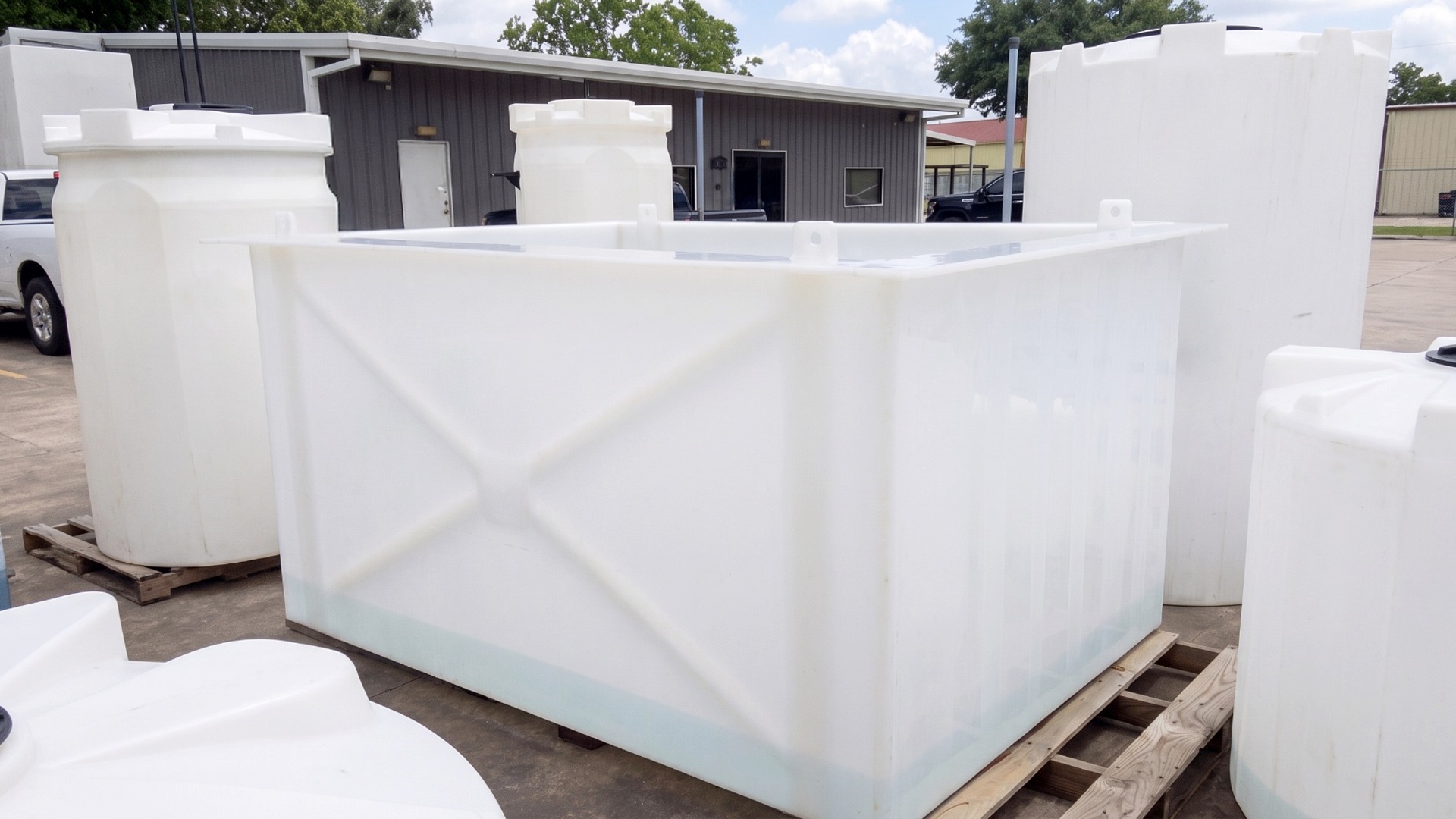
An image showing a custom, open top polypropylene tank with lifting lugs and sidewall reinforcements next to other poly tanks in a business yard
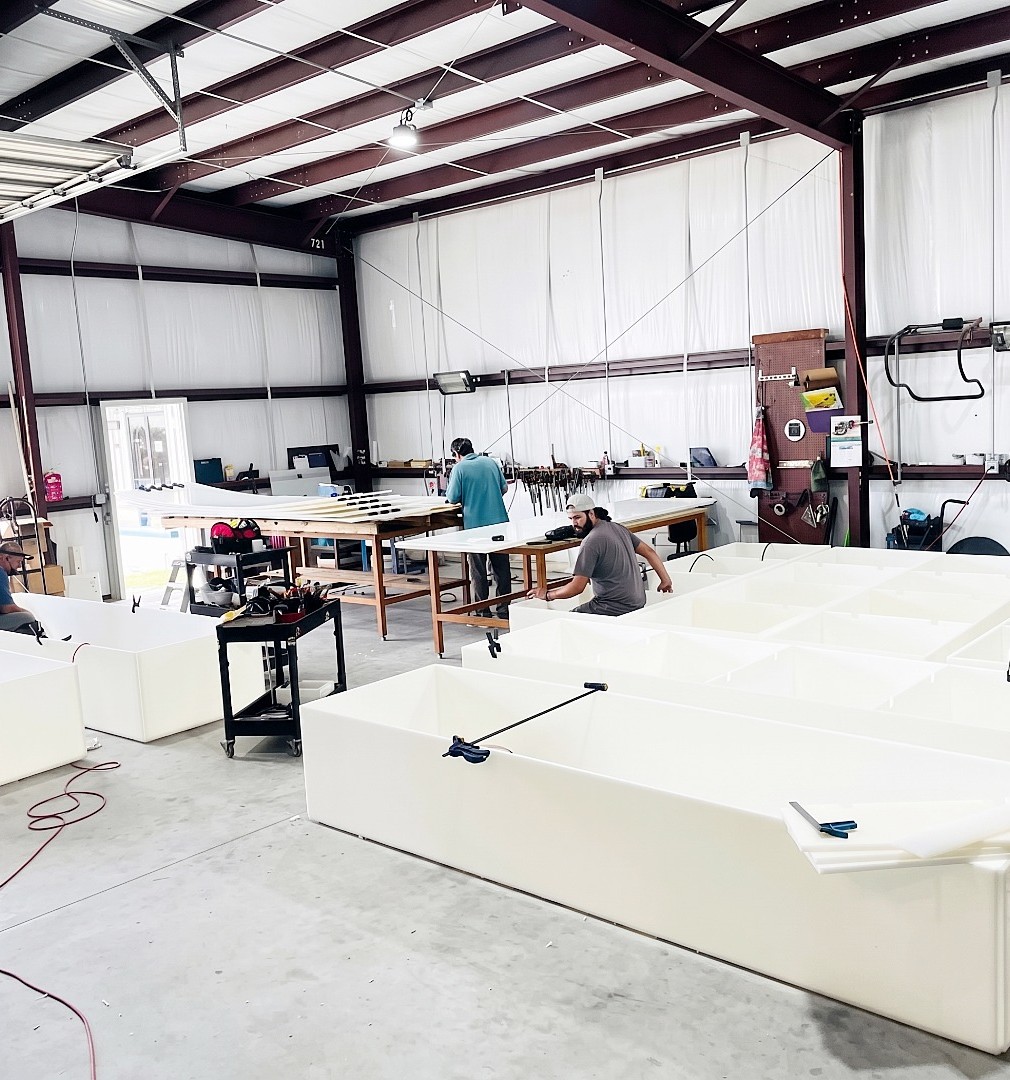
An image of the Protank custom tank fabrication team at work welding together large polypropylene tanks
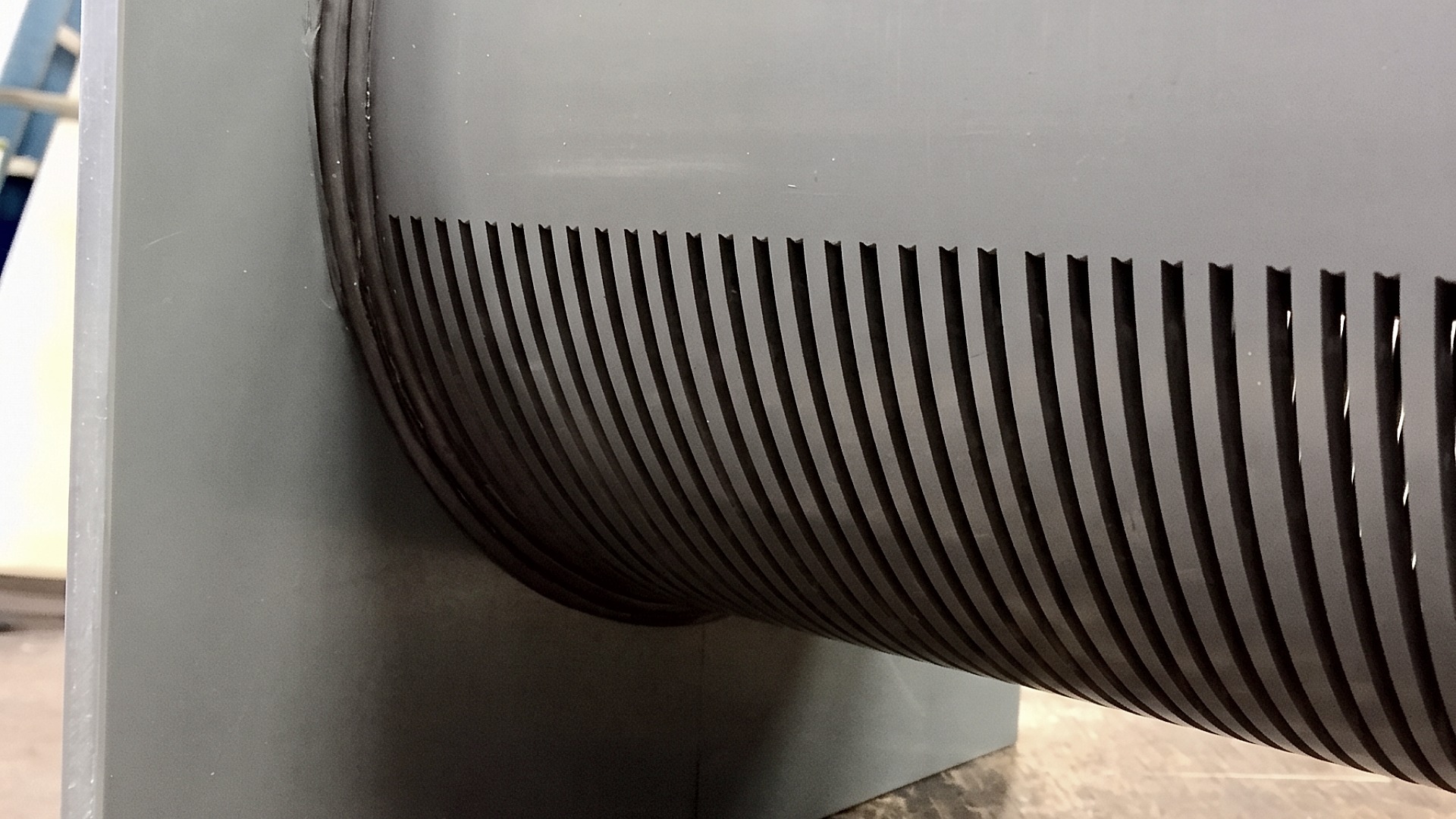
A close up image showing grooves cut into a custom pipe setup for use in air sparge mixing and blending tanks

Three Common Batch Blending Methods

The solution, batch size, and equipment used in mixing set the agitation method, and the method sets tank build and provisions. Three types cover nearly all blending work, and each one causes different vessel load stress.

Overhead Mixer
Highest Load
DriveMotor + impeller
Tank loadWeight · torque · thrust · bending
ProvisionsMount · baffles
For overhead mixers, a motor and gearbox drive an impeller on a shaft through the batch from above. This is the default for most blending, dilution, and solids suspension work, and is also the method that puts the most load strain on the tank. Tanks have to carry the mixer’s weight, the axial thrust of the impeller, the torque of the drive, and the bending moment the impeller generates in the liquid. Tanks can be built with mixer mounting provisions to match the equipment you supply, with structural reinforcement and wall thickness per load. Welded internal baffles are added to break the rotational flow and drive mixing.
Common tank types: agitated blending tanks, batch mixing tanks, polymer make-down tanks, baffled mixing tanks, and slurry suspension tanks.
Recirculation
No Top Load
DriveExternal pump
Eductor draw~4–5× pumped vol.
ProvisionsBulkheads · supports
For recirculation, a pump draws solution from the tank and returns it through nozzles or eductors inside the vessel. The benefit: no moving parts inside the tank and no top-mounted mixer load. Tank eductors draw roughly four to five times the pumped volume, so a modest recirculating pump moves a far larger volume through the batch than its own flow rate. Custom mixing tanks can be built with suction and return bulkhead fittings placed according to loop layout, internal pipe supports, and drain-side connections.
Common tank types: recirculating blend tanks, eductor mixing tanks, and jet mixed chemical tanks.
Air Sparge
Low Shear
DriveCompressed air
ActionBottom-up bubbles
ProvisionsPort · header · ring
For air sparging, compressed air is introduced below the liquid surface through a sparge port, header, or ring. The rising column of bubbles drives circulation from the bottom up without a mixer, pump, or moving parts in the batch. Air driven agitation is best suited for solutions that tolerate air contact and low-shear mixing. Tanks can be built with sparge bulkhead penetrations, internal header or ring with support, and freeboard for produced surface turbulence. If you do not have a sparger layout specified, Protank can recommend one for approval before production.
Common tank types: air agitated blending tanks, sparged mixing tanks, and air mixed chemical tanks.
Compatibility Note

Air sparging introduces air into the batch that is not suitable for every solution. Volatile or oxidation-sensitive chemicals and caustics that can absorb carbon dioxide from the air stream should be evaluated with your chemical supplier before air driven agitation is selected. For proprietary or altered solutions, compatibility must be confirmed through you and your chemical supplier, and Protank will build to the confirmed material and method.

Blending produces the solution, while metering to the next application point is a separate step. For chemical feed and metered supply, see our Custom Day Tanks & Dosing Tanks.

Have a batch to blend?Connect with us to discuss your application and get a free quote from Protank's fabrication team.
Request a Quote

Mixing & Blending Tanks Built to Your Specs

Agitation adds mechanical stress that a static storage tank never sees, so material and thickness are specified to the load as well as the solution. Protank’s custom blending tanks are fabricated to the job. Below are tank material options, build details, and component options.

Tank Materials

PP-H
Standard
Service180°F cont.
Polypropylene homopolymer. The standard for most blending and make-down, and for overhead mixer tanks. Higher rigidity than copolymer, which matters when a tank carries a mount. Heated service to 180°F continuous, 212°F intermittent.
PP-C
Impact
ServiceAmbient
Copolymer polypropylene batch tanks. Higher impact resistance than PP-H, suited to cold solutions, hard mechanical handling, and abrasive slurries. Ambient and unheated blending.
HDPE
Ambient
Service~120°F
For ambient blending only; HDPE tank service tops out near 120°F. Heated and material compatible solutions are recommended for PP-H rather than HDPE.
CPVC
Oxidizers
Service200°F cont.
For blending oxidizing and chlorinated solutions where polypropylene is a poor match, to 200°F continuous. Selection is driven by solution chemistry, not temperature alone. For caustic service, polypropylene is typically the more economical choice within its temperature range.
PVC
Mild Acid
Service140°F
For ambient and mild heated acid blending only; PVC is temperature limited to 140°F. Hot or aggressive acid service moves to CPVC or PVDF.
PVDF
Aggressive
Service~280°F
For strong oxidizers, aggressive acids, and high temperature service to roughly 280°F, beyond polypropylene compatibility. Not recommended for hot caustic. Strong polar or ester solvents can swell or stress-crack PVDF; always confirm solution-specific compatibility.
PP / standard blending Acid & oxidizer service Aggressive / high-temp
Steel (Sourced, Not Fabricated)

For mixing jobs above the thermoplastic range, or that require a pressure or vacuum rating. Thermoplastic tanks are ambient pressure vessels only. For these applications, Protank can source carbon or stainless steel vessels built to your provided engineering designs. For metal bridges, frames, and structural components on plastic blending tanks, Protank often can provide.

Build Details
Tank bodyPP-H / PP-C · PVC · CPVC · HDPE · PVDF · Steel (sourced)
Fittings & sealsPVDF · PVC · CPVC · EPDM · Viton · PTFE · FFKM · titanium
VolumeSmall batch to ~3,500 gal
Sheet thickness3/16″ – 1″
ReinforcementPP-encased steel · ribbing · girth bands
WeldingBead (hot-gas) · Extrusion

Mixer Mounting & Structural Reinforcement

Full mixer bridges for open top tanks, in polypropylene or metal, or reinforced mounting pads if the bridge is vendor supplied. Mounts are built to the footprint and bolt pattern of the equipment you supply.

A mixer’s weight, torque, thrust, and bending moment are stated on the manufacturer datasheet. Send those figures with your tank specifications and Protank can build the mount and supporting structure.

Structural reinforcement in external ribbing, girth bands, or tubular carbon steel, open or encased in polypropylene or HDPE, to carry a mixer or along the tank body to carry the batch. The option a tank receives depends on load, tank shape, and job specifics.

Welded Internal Baffles

Baffles welded into the tank rather than bolted later, meaning no fasteners, no crevices, and no dissimilar hardware sitting in the solution. Vertical mixing baffles on flat bottom and cone bottom tanks to break the rotational flow. Cross baffles are available for large rectangular transport tanks to control the movement of liquid during transit.

Number, width, and placement can be customized to your tank and agitation method.

Square and rectangular tanks are largely self-baffling in blending services since the corners double in breaking rotational flow. This is one reason why rectangular mixing tanks are common and when floor space is tight.

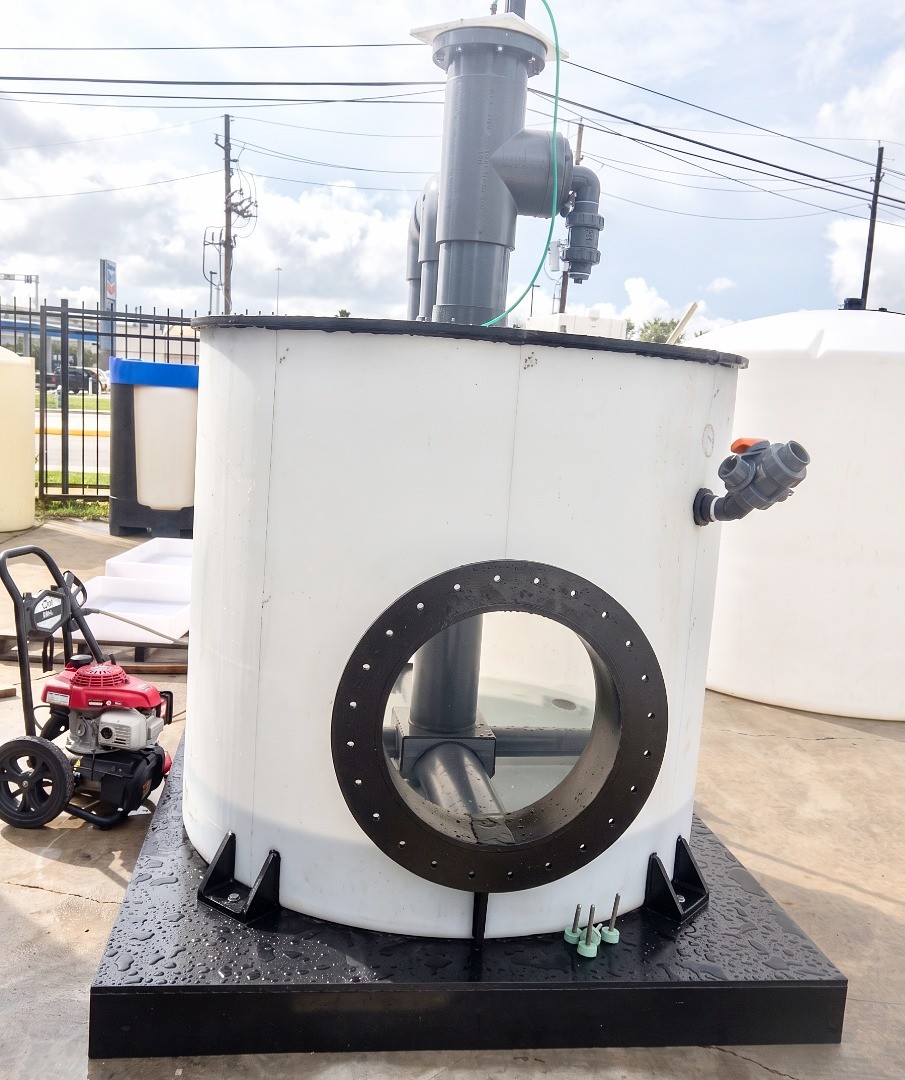
Custom polypropylene tank with fittings and internal air sparging plumbing setup visible through a large circular, sidewall-mounted viewport

Welded provisions, not retrofits

Baffles, sparge supports, and recirculation penetrations are welded in place during fabrication or integrated into a stock poly tank. The mount is built to accommodate your mixer, with wall thickness and reinforcement options available to meet the load the mixer puts into the tank, so the vessel carries the equipment instead of flexing under it.

Recirculation & Sparge Provisions

Internal piping manifolds to recirculate product through the tank with pipe supports and clips to maintain assembly position. Suction and return bulkhead penetrations sized and located for loop layouts. Pump inlet and outlet ports and in-line filtration connections. Vortex breakers and dip pipe options.

Air sparge rings and headers per specified layout and hole pattern, with bulkheads, internal supports, and freeboard for surface turbulence. If you do not have a pattern specified, Protank can recommend one for your approval before production.

Heating & Temperature

Heat tracing with programmable temperature control, and foam insulation with a weatherproof mastic jacket for outdoor tanks or heated batches held for long periods. (See also: Custom Heat Traced & Insulated Tanks.)

Heated blending narrows the material. Polypropylene carries heated service to 180°F continuous. Above that, or when solutions are aggressive and hot, PVDF or metal is recommended.

Tops, Lids & Access

Open top tanks for mixer mounts, bridges, or frames above the vessel, and for batches that have ingredients added by hand or hoist equipment.

Closed top tanks with a mounting nozzle or manway sized to the mixer, with charge ports, vent connections, and inspection access. Lids in polypropylene, HDPE, or polycarbonate, hinged or removable, in full or partial coverage.

Vapor and vent add-ons for solutions that offgas, including vented lids, fume lines, and connection points for an extraction or scrubber system. (See also: Custom Fume Scrubber Systems.)

Shape, Bottom & Solids

Rectangular, square, cylindrical, or fully custom asymmetrical shapes, sized to batch volume, floor plan, and overhead clearance for mixer shaft withdrawal.

Cone and hopper bottoms for full evacuation, gravity drain, and for slurry, solid suspensions, and solid handling. Full drain sumps and sloped bottoms so spent or off-spec batch can be fully removed. Rounded interior corners and a full range of solution-rated drain valves.

Sheet, Wall & Welding

Weldable plastic sheet stock from 3/16″ to 1″ thickness, to accommodate your solution’s specific gravity, thermal demands, and the mechanical load of the agitation method. Joined by hand and bead welding or extrusion welding depending on material, section thickness, and tank size.

Structural, Seals & Containment

Fittings in socket, threaded, or flanged in the type and construction material needed. For heated blending, account for thermal expansion in provided plumbing designs. Lifting lugs for installation and relocation. External ribs and frames for large volume tanks, to your specified requirements and load figures.

Gasket seals for ports, valves, and lids in a full range of material options to match the solution: EPDM, Viton (FKM), PTFE, and FFKM for specialty resistance and operating temperature.

Secondary containment options: integrated containment bases, double wall designs, or footprint sizing and drain placement for installation in berms or basins (See also: Custom Containment Tanks.)

Size & Freight

Protank fabricates tanks up to 8 feet tall, and up to 15 feet long at 4 feet tall or under, holding up to roughly 3,500 gallons. Larger is possible.

The practical ceiling is usually the truck, not the shop. Past roughly 8 feet in width or length a tank becomes a wide load, and freight cost rises sharply. When a tank has to exceed that footprint, Protank will tell you upfront what it will cost to move before you commit to the build, so the decision can be made with full numbers in front of you.

Need a blending tank?Connect with us to discuss your application and get a custom Protank quote.
Request a Quote

Industries That Use Blending & Mixing Tanks

Blending runs anywhere a chemical arrives at one concentration and has to be used at another, when ingredients or raw materials need mixing, or anywhere a solution has to stay uniform or suspended to work. The following are common applications and industries that use blending and mixing tanks.

Water & Wastewater Treatment

Dry chemical and polymer make-down is one of the most common agitation tank applications in the country. Dry or emulsion polymer is charged, wetted, and mixed until fully hydrated before it goes to the feed pump. Lime slurry, carbon slurry, and coagulant blending follow the same process. Solids that fall out of suspension when the mixer stops determines the agitation method and tank bottom design.

Chemical Manufacturing & Formulation

The second highest source of blending work. Formulators add raw materials, blend to a target concentration, and hold or draw off a finished product. Batches often vary from run to run, which means the tank has to handle a range of solutions, specific gravities, and temperatures rather than one fixed service. Industrial plastic mixing tanks and blend-and-hold pairs are common in these operations.

Coatings, Adhesives & Inks

Pigment dispersion, resin letdown, and solvent thinning all depend on sustained agitation, and many of these solutions are viscous enough that the mixer load on the tank is substantially higher than a water-like batch of the same volume. The properties of the solvents used also frequently drive material selection away from the standard polypropylene.

Agriculture & Fertilizer

Liquid fertilizer blending, micronutrient mixing, and diluting of crop protection chemicals. Blends are often made to order by a supplier for a grower or a field, which makes tanks that fully evacuate between batches essential so following blends are not contaminated by the last.

Metal Finishing & Plating

Bath make-up and replenishment. Plating, cleaning, and etching solutions are frequently mixed to concentration in a separate vessel before moving to use and keeps the process tank in production while the next batch is prepared.

Biofuel, Brewing & Distilling

The chemical and utility tanks that support a biological process, not fermentation. Methanol and catalyst blending for biodiesel, caustic clean-in-place activation, and byproduct handling. These operations often blend aggressive chemicals in plastic and run the biological jobs in steel.

General Manufacturing

Coolant and cutting fluid make-up, blending part washing solutions, and any operation or business that buys a concentrate and dilutes it on site.

Why We Build It Better

01

In-house fabrication

Every tank is built in the USA at Protank’s Gulf Coast facilities by our experienced fabrication team, which means direct quality control, consistent workmanship, and faster lead times than splitting a job across suppliers.

02

Built to carry your mixer

Mounting provisions fabricated to your actual equipment, with wall thickness and reinforcement specced to the load it puts on the tank. A mixer bolted to a vessel not built to hold it is the most common failure method for blending tanks, and the failure mode Protank builds against.

03

Welded provisions, not retrofits

Baffles, sparge supports, and recirculation ports welded in place during fabrication rather than added afterward. No fasteners in the solution, no crevices, no hardware working loose under vibration.

04

Material breadth

PP-H and PP-C, PVC, CPVC, HDPE, and PVDF for tanks; PVDF, PVC, CPVC, EPDM, Viton, PTFE, FFKM, and titanium for fittings and seals, to match your solution and workflow temperatures.

05

Retrofit and replacement

We can build replacements to drop into existing footprints for tanks that have cracked around a mount, failed at a bulkhead, or been outgrown by the job, eliminating the need to replace surrounding equipment.

06

Nationwide delivery, 20+ years

Completed tanks ship across the continental US from Protank’s Gulf Coast facilities, backed by two decades of custom tank fabrication.

Request Your Custom Blending & Mixing Tank

The fastest quote comes from a drawing, STEP file, or tank spec, along with the datasheet for the mixer you plan to install. Protank builds to what you provide. If you are still defining the tank, the following details help us match and build:

  • Solution being blended: The material(s) being added and blending goal, including concentration, specific gravity, and whether solids are involved.
  • Agitation method and equipment: Overhead mixer, recirculation loop, or air sparge. If you have selected a mixer, send the datasheet. Weight, torque, thrust, and bending moment are the properties that determine mount and reinforcement needs.
  • Batch conditions: Volume, operating temperature, indoor or outdoor, freeze exposure, and tank turnover.
  • Volume and footprint: Batch size, working depth, floor space, and overhead clearance for mixer installation and shaft withdrawal.
  • Connections and provisions: Fills, drains, vents, pump and filtration connections, baffles, sparge or pipe ports, containment, level indication, and monitoring.
Phone
866-776-8265
Email
sales@protank.com
Online
Message Us

Drawings, sketches, and engineered specifications are encouraged and, in some cases, required. Contact our fabrication team for a quote.

Send Your Specs. Request a Quote

Response time: We'll get back to you within one to three business days.
Contact