
Your browser is not supported. For the best experience, you should upgrade to a modern browser with improved speed and security.

Underground Water Tanks
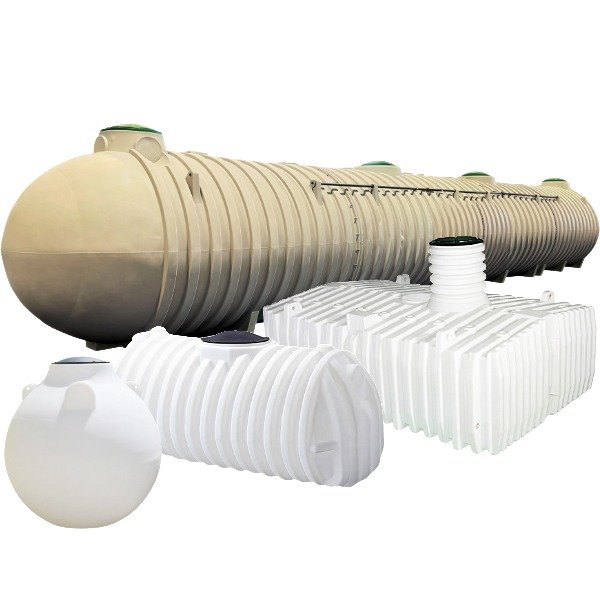
Protank Underground Water Tanks

Underground water tanks are one piece, seamless polyethylene cisterns engineered to withstand the physical demands of being buried. They are also known as cisterns, water holding tanks, and below grade water tanks. The tanks are ribbed and/or reinforced to handle the outside load from earth and backfill rather than internal water head like an above ground tank. They are recommended for water, mild wastewater, rainwater, and stormwater usage only. Select models can serve as non-potable / septic holding where local codes permit, but dedicated septic tanks are recommended for waste applications.

Plastic underground water tank benefits include: freed up surface space, concealed installation, sunlight-protected water for quality and algae prevention, and protection against freezing by putting water below the frost line. Choosing a cistern starts with the site details: use case, and therefore total capacity and certification requirements, how much soil depth cover will sit over the tank, local groundwater and soil conditions, and whether the tank or area will be driven or parked over. These details influence which underground water tank model fits the application.

Tell us capacity, potable or non-potable use, available burial depth (top cover), site water table / soil conditions, whether vehicles will cross over the tank, and your delivery ZIP. We'll match you to the right model, riser, fitting package, freight, and lead time.


How to Choose an Underground Water Tank

1. Match Tank Profile & Water Table

Three underground water tank model types are suitable for most sites. The spherical cisterns (approx. 250 to 600 gal) are compact in shape for smaller storage needs and tight footprints. The low profile cisterns (around 51″ in height) are long and shallow for installs with less excavation while staying above seasonal, high water tables or shallow rock layers. Large volume underground water tanks range from 10,000 to 20,000 gallons and are long horizontal cylinders ideal for bulk reserves, fire protection storage, bulk rainwater harvesting, and high capacity stormwater management at commercial properties, industrial facilities, municipal buildings, and institutions.

2. Confirm Burial Depth (Cover) Rating

Every underground water tank model has a minimum and maximum soil cover over the top of the tank. Often 6″ minimum and 36″ maximum; values vary by tank due to engineered design and manufacturing specs. For some tanks, local groundwater or frost line depth determine product suitability based on acceptable burial range. For others, above ground activities (mowers, foot traffic, small equipment) or the required pitch for gravity fed plumbing influence burial depth and suitable tanks.

Site conditions vary widely by region, and local regulations often have specific minimum cover and line depth requirements. A professional site evaluation and compliance check with the governing authority is highly recommended before ordering an underground water tank. If a cistern is set too shallow, stormwater runoff infiltration, shifting soil, and freezing can become a concern. If set too deep, the installation risks exceeding the tank's load rating and groundwater infiltration. We can help confirm the rated cover range of a tank against your specified site requirements.

3. Rate Site for Traffic Load & Structures

Standard poly underground water tanks are not rated to be driven over. If a vehicle, trailer, or heavy equipment will ever cross the tank installation area, that load has to be carried by an engineered cover, such as a reinforced slab or bridge, not by the tank, while still leaving the riser and manway accessible at grade. For sites where traffic load is required, underground fiberglass tanks are available in traffic-rated options (e.g., H-20 highway loading) unavailable in polyethylene cisterns. Tell us your site and load requirements and we can help you find the right tank.

Permanent structures should not be built over buried cisterns as the tanks are not designed to bear permanent structural loads, and anything on top blocks the riser, pump service, and potential future replacements. Siting also has to respect local setbacks from foundations, wells, and septic fields. Always confirm placement against your site plan and local code.

4. Plan Buoyancy, Water Table & Anchoring

Due to buoyancy, an empty poly cistern in a high water table can float up out of the ground before it's backfilled or after a full pump-out. Several buoyancy mitigation options are used to alleviate underground tank floating including ballasts, hold-down straps, deadman anchors, and anchored pads. Ribbed cisterns 600 gallons and up should not be pumped dry and need to be kept roughly one-quarter full once installed so external soil pressure doesn't cause deformation and damage to the tank. Sites with high groundwater and saturated soil often require counter-buoyancy measures specific to the site and tank model.

5. Spec Access, Risers & Fittings as a Buried System

The tank is one part of a working underground install that also needs: a manway riser to bring access up to grade, lid(s), bulkhead fittings, piping, and a pump. A level sensor for volume monitoring is recommended. Fittings are generally not pre-installed. Tanks ship with molded-in fitting flats for setting field plumbing. Maximum acceptable bulkhead size is model specific. Risers and manhole extensions are sectional and customizable to adapt access to cover depth. We offer underground tank riser and fitting packages that can be added into quotes so the tank arrives ready for installation.

Underground Water Tank Specifications & Logistics

NSF Marking Note: Which plant(s) or state(s) can furnish a marked unit is per-SKU. If your jurisdiction requires the NSF mark (e.g., California), tell us your state or ZIP and we'll confirm a marked tank for the order.

Underground Water Tank Sizes & Dimensions

Common Underground Water Tank Sizes
Capacity L × W × H Model / Type Part #
250 gal 47″ × 47″ × 56″ Sphere UWN250
550 gal 64″ × 64″ × 67″ Sphere UWN550
575 gal 97″ × 48″ × 42″ Low profile UWN575
1,175 gal 127″ × 60″ × 51″ Low profile UWN1175
1,700 gal 135″ × 55″ × 70″ Ribbed UWN1700
2,500 gal 159″ × 99″ × 51″ Low profile UWN2500
5,025 gal 211″ × 102″ × 96″ Large UWN5025
10,000 gal 356″ × 101″ × 107″ Large horizontal cylinder UWN10000
20,000 gal 665″ × 101″ × 107″ Large horizontal cylinder UWN20000

Common underground cistern sizes outlined above. Dimensions and cover ratings may vary by model. Always confirm exact specs match application needs before quoting.


Underground Water Tank Materials, Standards & Compliance

Build

Underground water cisterns are one piece, seamless, rotationally molded high density polyethylene (HDPE) with no seams, welds, or full tank gaskets to fail or weep underground. Polyethylene is inherently resistant to natural soil profiles and will not rust or corrode in the ground. Excluding spherical models, tank walls are reinforced with ribbing to carry external soil and backfill pressure. This is the opposite of above ground tanks that are engineered to hold internal water load, and the reason why an above ground tank should not be buried and an underground tank not be used above ground.

Potable water certification

There are three distinct tiers when it comes to potable water and polyethylene tanks, and it's important to know which one a product's specifications refers to and how it applies:

  • FDA compliant resin (21 CFR 177.1520): The baseline requirement specifying that the polyethylene used in construction is a food contact grade material; describes the raw material only.
  • NSF/ANSI 61 approved resin: A stronger approval indicating the material intended for long term, repeat water contact meets NSF/ANSI 61 requirements; what NSF 61 Approved Resin labels mean; a material statement, not finished tank certification.
  • NSF mark ("sticker") on the finished tank: Certification for the actual tank product; the NSF states that only NSF mark bearing products are certified; tank certification is granted at the manufacturing plant level.

NSF/ANSI 61 approved resin and an NSF marked tank are not the same claim. When an application requires the NSF mark for potable storage, tell us your state or delivery ZIP and we'll supply a marked tank sourced from a covered plant. When it isn't required, the NSF 61 approved resin and FDA compliance stand behind potable use.

ASTM D1998

This standard governs upright, atmospheric, one piece rotomolded vertical tanks ≥500 gallons and does not apply to underground tanks, which experience a different load stress. If you need documented upright bulk engineering, see our Engineered ASTM D1998 Upright Storage Tanks.

Temperature

HDPE is rated for continuous service up to ~120°F. Both the tank's chemical compatibility and structural rating derate (decrease) as service temperature rises. For any polyethylene tank, always confirm suitability at your actual service temperature, not the 73°F base rating alone. Buried service is naturally temperature-stable and, below the frost line, freeze-protected.

Specific gravity

Plastic underground water tanks are rated to 1.9 SG. This is higher than a typical above ground water tank (SG ~1.0), because it correlates to tank wall thickness and underground tanks require thick, engineered walls to handle the weight and pressure of soil and condition variations that change with precipitation. For suitable, water-based applications, the specific gravity rating of these tanks is more than adequate.

Rated for burial, not for chemicals

The specific gravity rating on underground water tanks exists to survive external soil and backfill load, not to certify chemical handling. Underground poly cisterns are built and sold for water and some wastewater service, meaning potable and non-potable water, irrigation and stock water, fire reserve, rainwater, and (where code acceptable) as holding tanks. They are not rated for chemicals or fuels. Buried tanks can't be easily inspected or integrity-checked the way above ground tanks can; a further reason chemical duty isn't recommended. If you need below grade storage for fuel, aggressive, or regulated chemicals, consider an underground fiberglass tank.

Underground Water Tank Features → Applications

Underground water tanks have a few distinctive features beneficial to general applications and some specific use cases.

Ribbed, one piece body (external load design)

The corrugated wall and molded ribs let the tank shell resist earth and backfill pressure from outside.

Ideal for: any buried potable or non-potable reserve where the tank must survive soil load. De-risk: cover depth and backfill requirements are model specific; free flowing native soil may be acceptable backfill, but must be free of wood, masonry debris, silt, and sharp objects.

Low profile geometry

A long, shallow tank installs with less excavation to help avoid shallow water tables and rock.

Ideal for: high water table sites, shallow rock sites, and reaching the frost line without a deep dig. De-risk: confirm the model's cover range and any buoyancy mitigation necessary for the site's groundwater.

Manway, tank risers for at-grade access, and flats for field plumbing

Access and plumbing must be brought up from the buried tank to the surface for use, service, and modifications. Because a buried tank can't be visually inspected, a level sensor or monitor can be considered close to essential rather than optional and should be planned for.

Ideal for: hauled-in potable supply, well supplementation, rainwater harvesting cisterns, irrigation reserve, fire protection, and emergency water storage. De-risk: fittings typically do not come installed; select the riser, lid, bulkheads, pump, and sensors as a system so the install is complete.

The underground installation

Burial frees surface space, hides the tank, keeps water cool and dark to control algae and quality, and protects against freezing temperatures during winter.

Ideal for: saving space at residential homes, campgrounds, and RV parks, rural fire reserve, discreet rainwater harvesting, and general water storage in cold climates. De-risk: the site controls system specifications and installation methods such as cover depth and buoyancy controls.

Underground Water Tank System Integration

An underground water tank operates as a system, and a few integration points can help prevent the most common field failures. Those that apply are specific to the model and site and are provided as general recommendations.

Vacuum relief on pump-out

The same tank wall that is built to resist soil load can be collapsed by negative pressure from the inside. High GPM pumps can draw water faster than air can re-enter and pull a vacuum against the tank. The system has to admit air through a vent or vacuum relief sized to at least the peak discharge rate with the opening screened against insects and rodents.

Flexible connectors at every penetration

Native backfill settles over the following months after installation. Rigid pipes that are solvent welded straight to a bulkhead can transfer that ground movement into the fitting and shear it off the wall. Transition through flexible connectors or expansion couplings close to each tank penetration before setting rigid underground pipe. Rigid connections without flex can also void the tank warranty.

Floating suction intake (accessory)

Water stored in a polyethylene cistern is cleanest below the surface and above any settled silt at the bottom. A floating suction assembly can be used to draw from just under the top of the water column rather than the floor or surface. This underground water tank accessory is worth considering for potable systems and long term reserves.

Watertight riser & secure lid

Surface runoff can leak into a buried cistern and is a common contamination path for potable and rainwater systems. To limit this concern, bring the manway above finished grade with a riser and complete it with a gasketed, watertight lid. When the tank is easily accessible, a lockable or child resistant lid should be used and may be required by code.

Common Underground Water Tank Applications

Application Typical service What drives selection
Potable reserve / well supplement Hauled-in or well drinking water NSF marked product for the jurisdiction; potable fittings; level sensor
Irrigation & agricultural reserve Non-potable field, stock, or irrigation water Capacity vs draw rate; low profile for shallow / high water table sites
Rainwater / stormwater collection Roof / site runoff (treat before any potable use) Inlet / filter fittings; overflow; buried siting; for above ground, see Rainwater Collection Tanks
Fire & emergency reserve Private fire suppression or standby water Capacity to regulations; draft / suction fittings; private fire storage is code regulated (e.g., NFPA 22); verify build / listing requirements with your fire marshal.
Multi-use / holding Potable or non-potable water; septic / wastewater holding where code-approved Model rated multi-use; water / wastewater only (not chemicals); local code path for any waste use

The above is representative of common applications for underground cisterns, not an endorsement of compatibility. These are water and mild wastewater tanks, and are not rated for corrosive chemicals or fuel. Always confirm model and certification compatibility for your use case.

Select cistern models can be used as underground holding or pump tanks when codes allow. For wastewater or septic service specifically, choose a septic tank engineered for the application.


Freight & Delivery Logistics

Underground water tanks ship LTL or flatbed. Low profile cisterns are long, up to ~13 ft, and the largest models run up to ~55 ft, so many exceed standard liftgate ratings and need a forklift or lifting equipment on site to receive. Handle and lift by the molded lugs only using all lugs at once. Only lift tanks when empty. Tanks may be in stock at one of our warehouses or sourced factory-direct and are produced at multiple U.S. plants. We route each order from the origin nearest your site to cut freight cost and transit time, and we quote honest lead times by size, color, and stock. Tell us the delivery site and any access limits such as narrow road, no forklift, liftgate-only and we'll build freight around it.

Ready to spec your underground tank?Request a quote or talk with one of our underground water tank specialists. We can help confirm the right model, riser and fitting package, certification for potable applications, and freight requirements.
Request a Custom Quote


Frequently Asked Questions About Underground Water Tanks

No, and this is a potentially costly mistake. The reason: an above ground water tank is engineered to hold water pressure that pushes out from inside the tank. It is not designed for and has no structure to resist soil pressure pushing in, so when buried, its walls can collapse. Underground tanks are built differently. They have thicker walls and are reinforced with ribs on some models to withstand the external earth load. In short, if a tank isn't rated and sold for burial, it can't go into the ground.

They can look similar and even share a mold family, but they're specified for opposite jobs. An underground water tank (cistern) stores clean water, potable or non-potable, and potable models use FDA compliant resin. A septic tank holds and treats wastewater, may or may not be made from FDA compliant materials, and is typically independently approved for septic systems by your local government. Don't substitute one for the other: a cistern isn't an approved septic tank, and a septic tank isn't approved for drinking water. For waste tanks, see our septic tanks.

No, these cisterns are rated for water and mild wastewater: potable and non-potable water, irrigation, fire reserve, rainwater, stormwater, and as holding tanks when local codes permit. Their 1.9 specific gravity rating is engineered for burial load, not chemical compatibility, and a buried tank can't be inspected or monitored the way an above ground chemical tank can. For underground fuel or chemical storage, consider a fiberglass tank built and listed for it.

In order of operations:

  1. Professional site evaluation to determine groundwater levels and seasonal variations.
  2. Regulatory permitting and installation compliance, (application specific).
  3. Buying and receiving an underground water tank.
  4. Engineering calculations for buoyancy control if required.
  5. Excavation to the required depth, (bed + tank height + rated cover), which can exceed 7' on larger tanks.
  6. Backfill selection and purchase if native soil is unacceptable.
  7. Tank bed leveling, fill, and compacting as needed.
  8. Tank placement in the excavation.
  9. Leak testing and initial rinse/flush.
  10. Buoyancy mitigation installation, if applicable.
  11. Adding backfill and compacting in layers up to fitting installation height while still leaving room, (some models require water-fill alongside backfill layers).
  12. Adding fittings, vacuum relief vent, routing piping / flexible connectors to and from the tank.
  13. Installing accessories (manhole extensions, pump, level sensor).
  14. Completing backfill with a slight, elevated mound to direct precipitation away from the tank and account for soil settling.

It depends on the model. Each tank is rated for a minimum and a maximum depth of soil cover over its top, and that range differs from tank to tank. Some models also decrease in depth tolerance with site groundwater levels. Common minimum / maximum soil cover for underground water tanks ranges from 6 to 36 inches. This does not include the tank height, which can bring total excavation / burial depth to 7' or more.

For many of our cisterns, free flowing native soil from the excavation can be used as backfill, provided it's free of wood, masonry debris, silt, and sharp objects that could puncture the tank. Some models and site conditions call for a clean sand / gravel (pea gravel) bedding and backfill instead. Backfill is commonly placed and compacted in layers. Always refer to and follow a specific model's installation instructions.

Stored correctly, water in a sealed underground cistern stays usable for a long time. Below grade installation helps keep water cool, dark, and at a near-stable temperature year round. This slows the algae and bacterial growth that sunlight and heat can cause in an above ground tank. Water quality depends more on how the system is set up and maintained than total time in the tank. To maintain water quality, keep the tank sealed against surface runoff and light, screen every vent and inlet against pests and debris, and for potable uses, start with potable safe water and disinfect / treat according to recommended guidance.

Often, yes. Below grade tanks frequently fall under local building, plumbing, health, or fire codes. This is especially common for potable water provision systems and fire reserve installs. Requirements vary by jurisdiction and by what the water is for, so this must be confirmed with the local authority having jurisdiction (AHJ) before you dig. We can tell you what the tank is rated and certified to; the permit and approval are yours to secure.

An empty underground poly tank can float in a high water table, before backfill or after if pumped dry or not properly installed, because the surrounding groundwater pushes it up. This is why ribbed cisterns of 600 gallons and larger should not be drained below 1/4 full once installed, and why high groundwater or saturated soils can require counter buoyancy measures like ballast, hold-downs, or an anchored pad.

Yes, if the system isn't properly vented. Removing water with a high GPM pump faster than air can re-enter the tank creates a vacuum that can cause atmospheric pressure to collapse the tank wall. This is a real failure mode even on correctly buried tanks. The fix is straightforward: the system must admit air, through a vent or vacuum relief sized to accommodate the peak discharge rate, at minimum. These openings should be screened to keep animals and insects out of the cistern. Double verify and confirm venting against your actual pump and outlet before system startup.

No, not over a standard underground plastic water tank; these are non-traffic rated. If the tank must sit under a driveway, lane, or any area that sees vehicles or heavy equipment, the traffic load must be carried by an engineered cover such as a reinforced slab or bridge, never by the tank itself. This setup must still allow for tank manway access and cannot fully encapsulate the tank. For applications that require traffic rated underground tanks, request an H-20 highway loading fiberglass tank.

It depends on capacity, model type, certification, the riser and fitting package, and closest FOB point to your site. This is why these are quoted products rather than listed with fixed prices. A way to access the water will be required, meaning a water pump and piping will also be needed and considered in your budget and planning.


Related Products


Name Length Width Height Size Part
250 Gallon Underground Water Tank 47" 47" 56" 47 L
47 W
56 H
UWN250
325 Gallon Underground Water Tank 54" 54" 54" 54 L
54 W
54 H
UWN325
325 Gallon Underground Water Tank 48.5" 48.5" 53" 48.5 L
48.5 W
53 H
UWS325
550 Gallon Underground Water Tank 64" 64" 67" 64 L
64 W
67 H
UWN550
575 Gallon Underground Water Tank 88" 48" 44" 88 L
48 W
44 H
UWS575
575 Gallon Low Profile Underground Water Tank 97" 48" 42" 97 L
48 W
42 H
UWN575
600 Gallon Underground Water Tank 101" 51" 47" 101 L
51 W
47 H
UWN600
1175 Gallon Low Profile Underground Water Tank 127" 60" 51" 127 L
60 W
51 H
UWN1175
1200 Gallon Underground Water Tank 100" 64" 62" 100 L
64 W
62 H
UWS1200
1200 Gallon Underground Water Tank 102" 60" 63" 102 L
60 W
63 H
UWN1200
1425 Gallon Low Profile Underground Water Tank 157" 60" 51" 157 L
60 W
51 H
UWN1425
1450 Gallon Low Profile Underground Water Tank 157" 60" 51" 157 L
60 W
51 H
UWN1450
1700 Gallon Underground Water Tank 135" 55" 70" 135 L
55 W
70 H
UWN1700
1725 Gallon Low Profile Underground Water Tank 157" 69" 51" 157 L
69 W
51 H
UWN1725
1750 Gallon Low Profile Underground Water Tank 157" 69" 51" 157 L
69 W
51 H
UWN1750
2000 Gallon Underground Water Tank 126" 98" 51" 126 L
98 W
51 H
UWN2000
2000 Gallon Underground Water Tank 126" 98" 51" 126 L
98 W
51 H
UWN2000
2500 Gallon Underground Water Tank 159" 99" 51" 159 L
99 W
51 H
UWN2500
2600 Gallon Underground Water Tank 155" 99" 51" 155 L
99 W
51 H
UWN2600
2650 Gallon Underground Water Tank 155" 99" 81" 155 L
99 W
81 H
UWN2650
3525 Gallon Underground Water Tank 211" 102" 51" 211 L
102 W
51 H
UWN3525
5025 Gallon Underground Water Tank 211" 102" 96" 211 L
102 W
96 H
UWN5025
10000 Gallon Underground Water Tank 356" 101" 107" 356 L
101 W
107 H
UWN10000
15000 Gallon Underground Water Tank 511" 101" 107" 511 L
101 W
107 H
UWN15000
20000 Gallon Underground Water Tank 665" 101" 107" 665 L
101 W
107 H
UWN20000